
Few works of literature have travelled as far, or lasted as long, as The Odyssey. Filled with monsters, shipwrecks, disguises, clever tricks and interfering gods, Homer's ancient Greek epic has inspired new stories and interpretations for centuries — from James Joyce's 1922 novel Ulysses to Christopher Nolan's 2026 film adaptation.
Traditionally attributed to Homer, The Odyssey follows Odysseus, king of Ithaca, as he tries to return home after ten long years fighting in the Trojan War.1 His journey takes him across dangerous seas and to strange islands full of monsters, magic and temptation. Back home, meanwhile, his wife Penelope and son Telemachus face a different threat entirely: a group of suitors occupying the palace and competing to take Odysseus's place.
How much of the journey do you remember? Work through the questions below to find out whether you're a lost sailor, an Ithacan explorer, or a true master of The Odyssey.
Quiz
Quiz :


📜Who Wrote The Odyssey, and Why Does It Still Matter?
The Odyssey is traditionally credited to Homer, the same poet associated with The Iliad. But scholars still can't confirm whether "Homer" was a single historical person2, or a name attached to generations of oral poets who shaped the story over time — a puzzle known as the "Homeric Question." The poem is thought to date from around the 8th century BCE, growing out of a long oral storytelling tradition long before it was ever written down.
That history of oral storytelling is worth pausing on, because it isn't so different from traditions much closer to home. Singapore's own founding legend comes down to us through a similar oral-to-written journey: the story of Sang Nila Utama sighting a strange beast — later identified as a lion, giving Singapura its name — was passed down for generations before being recorded in the Sejarah Melayu (the Malay Annals), much as generations of Greek performers shaped The Odyssey long before it was ever fixed on the page. Approaching Homer's epic with that lens can make it feel a lot less distant than "3,000-year-old Greek poem" might suggest at first glance.
No — Odysseus, the Cyclops, Circe and the poem's supernatural events all belong to Greek mythology, and there's no solid historical evidence that Odysseus himself was real. However, archaeological evidence does suggest that Troy was a real Bronze Age settlement3, meaning the poem may preserve distant, reshaped memories of real conflicts in the ancient Mediterranean — even if the gods, monsters and magic are pure myth.
❤️Why The Odyssey Resonates With Singaporeans
At its heart, The Odyssey is a story about nostos — the Greek concept of a hero's return home — and about whether home, and the people in it, can ever be quite the same after a long absence. That theme lands differently depending on where you're reading from, and it happens to land particularly well here.
Anyone who has experienced the particular feeling of returning to Singapore after years studying overseas — or who has family scattered across different countries for work, only reuniting during Chinese New Year, Hari Raya or year-end holidays — will recognise something of Odysseus's anxiety in the poem: will home still feel like home? Will the people who stayed behind still recognise you, and will you still recognise them?
Penelope's twenty-year wait, Telemachus growing from an uncertain young man into someone capable of defending his family's household, and Odysseus's own struggle to prove his identity once he finally arrives — these are exaggerated, mythologised versions of a very ordinary experience of distance and return that resonates in a nation built on generations of migration.
As you can imagine, there's much to cover about Homer's poem, which spans 24 books - and perhaps you've now found yourself with even more unanswered questions. If you're like many fans of The Odyssey (and, bonus points if you enjoyed Nolan's recent film adaptation), you might have many of your questions answered here in this video!
The poem's emphasis on xenia, or hospitality — the ancient Greek obligation to welcome and protect guests — also resonates strongly in Singapore's multicultural social fabric, where hospitality customs from Malay, Chinese, Indian and Peranakan traditions alike place real weight on welcoming guests properly, whether it's serving tea to visitors or never letting a guest leave a home hungry.
The Phaeacians who host the shipwrecked Odysseus, and the loyal swineherd Eumaeus who shelters him without knowing who he really is, would feel instantly familiar to readers raised with strong hospitality customs of their own. The suitors, by contrast, abuse that same custom by occupying Odysseus's home and consuming his household's wealth — which is precisely why their behaviour reads as so shocking within the story's own moral logic.
🏹Key Odyssey Characters to Know Before You Start
| Character | Type | Role |
|---|---|---|
| Odysseus | Human | King of Ithaca and the poem’s central hero, who struggles to return home after the Trojan War |
| Penelope | Human | Queen of Ithaca and Odysseus’s wife, who uses patience and cunning to resist her suitors |
| Telemachus | Human | Son of Odysseus and Penelope, who searches for news of his father and helps him reclaim the palace |
| Athena | Goddess | Goddess of wisdom and Odysseus’s principal divine supporter |
| Poseidon | God | God of the sea and Odysseus’s chief divine opponent, who obstructs his voyage home |
| Polyphemus | Cyclops | Son of Poseidon who traps Odysseus and his crew in his cave |
| Circe | Goddess and enchantress | Transforms members of Odysseus’s crew into pigs before later helping him continue his journey |
| Calypso | Goddess and nymph | Keeps Odysseus on the island of Ogygia and offers him immortality if he remains with her |
| Scylla | Sea monster | Lives in a cave above a narrow sea passage and seizes six members of Odysseus’s crew |
| Charybdis | Sea monster | Creates a deadly whirlpool on the opposite side of the passage from Scylla |
| Helios | God | Sun god whose sacred cattle are killed by Odysseus’s crew despite warnings not to harm them |
| Eumaeus | Human | Odysseus’s loyal swineherd, who shelters him when he returns to Ithaca in disguise |
| Eurycleia | Human | Odysseus’s former nurse, who recognises him by the scar on his leg |
| Tiresias | Human spirit | Dead Theban prophet whom Odysseus consults in the Underworld for guidance about his journey home |
| Nausicaa | Human | Phaeacian princess who finds the shipwrecked Odysseus and helps him reach her parents’ palace |
| Antinous | Human | One of the leading and most aggressive suitors occupying Odysseus’s palace |
Some of the most important moments in The Odyssey take place around meals, at doorways and beside beds rather than on the open sea.
Throughout the poem, characters are often judged by how they treat strangers, guests and vulnerable people. Generous hosts such as the Phaeacians help Odysseus continue his journey. Eumaeus welcomes a stranger into his home even though he has little wealth to share.
Polyphemus does the opposite: instead of protecting his visitors, he traps and eats them. The suitors also abuse the customs of hospitality by occupying Odysseus’s palace, consuming his wealth and disrespecting his family.
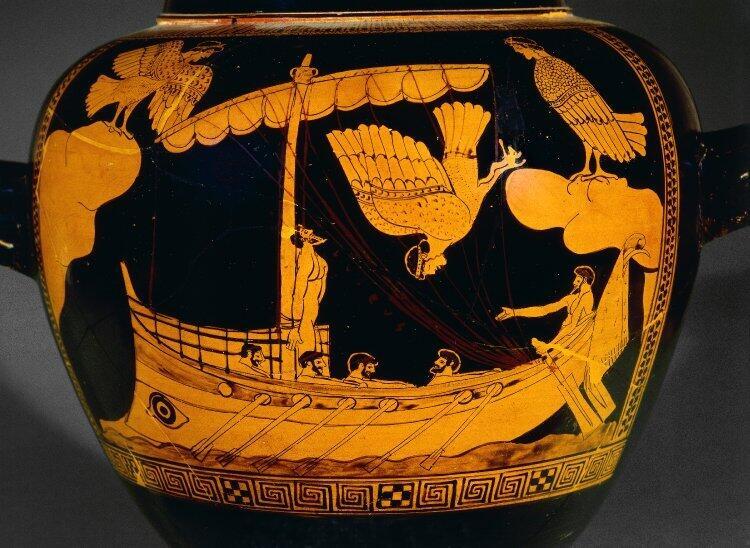
In this red-figure stamnos, also known as the Siren Vase (480-470 BCE), Odysseus, tied to the mast of his ship, is vulnerable to the Sirens’ deadly song while his crew row past.
Identity matters just as much as monsters do. Odysseus survives by using false names, disguises and invented personal histories. When he finally reaches Ithaca, defeating the suitors is not his only challenge. He must also reveal—and, in some cases, prove—his identity to Telemachus, his servants and Penelope.
That recognition happens gradually. Telemachus learns the truth after Athena changes Odysseus’s appearance. Eurycleia, his former nurse, recognises a scar on his leg. Argos, Odysseus’s ageing dog, needs no explanation at all: he simply recognises his master.
Penelope requires more convincing. This is why the final test involving the olive-tree bed matters so much. She does not accept the stranger simply because he looks like Odysseus or claims to be him. She accepts him because he understands a private detail about the home and marriage they built together.
📖Important Themes in The Odyssey
Odysseus’s voyage back to Ithaca drives the poem, but his homecoming involves more than reaching the island. He must reunite with his family, establish his identity and restore order to his household.
The ancient Greek custom of xenia established obligations between hosts and guests. The poem repeatedly contrasts those who welcome and protect strangers with those who mistreat guests or exploit their hosts. The Phaeacians and Eumaeus respect these obligations, while Polyphemus and the suitors violate them.
Odysseus survives by controlling what other people know about him. He calls himself “Nobody”, invents false personal histories and returns to his own palace disguised as a beggar.
Odysseus’s long absence tests the loyalties of his family, servants and subjects. Penelope, Telemachus, Eumaeus and Eurycleia remain committed to him in different ways, while the suitors and some members of the household take advantage of his absence. The poem also asks how loyalty can be recognised and proven after years of uncertainty.
Odysseus and his crew repeatedly encounter forces that threaten to delay or prevent their return. The Lotus-Eaters encourage forgetfulness, the Sirens lure sailors with their song and promised knowledge, and Calypso offers Odysseus immortality if he remains with her. These episodes explore the difficulty of remaining focused on home when confronted by danger, desire or escape.
Odysseus values recognition and wants his achievements to be remembered. This concern for reputation forms part of his heroic identity, but it can also lead him into danger. After escaping from Polyphemus, he reveals his real name despite his crew’s warnings, enabling the Cyclops to ask Poseidon to punish him.
Whether you remembered every stage of the voyage or became lost somewhere between Circe’s island and the Sirens, The Odyssey rewards a second look. Its gods and monsters make the poem exciting, but its lasting power comes from its questions about family, identity, intelligence, loyalty and the meaning of home.
After all, reaching Ithaca is only part of Odysseus’s challenge. The harder task is proving that, after everything he has experienced, he still belongs there.
Now it’s your turn: Odysseus faces monsters, magic and divine punishment on his journey home. Which challenge would you be most determined to avoid? Vote below and see whether other readers agree.
Which part of Odysseus’s journey would you least want to face?
References
- Homer, Odyssey, Book 1, line 1. (n.d.). https://www.perseus.tufts.edu/hopper/text?doc=Perseus%3Atext%3A1999.01.0136
- Dunn, D. (2020, January 22). Who was Homer and did her write the Odyssey? | British Museum. The British Museum. Retrieved August 17, 2026, from https://www.britishmuseum.org/blog/who-was-homer
- Donnellan, V. (2019, June 18). The myth of the Trojan War | British Museum. The British Museum. Retrieved August 17, 2026, from https://www.britishmuseum.org/blog/myth-trojan-war
Summarise with AI:
Did you like this article? Leave a rating!

 Loading...