
When learning an instrument comes to mind, we often think of the piano, but have you considered learning to play the guitar? One of the main reasons a guitar is a better instrument than a piano is that it’s easily transportable. Unlike a piano, a guitar can be carried around easily, making practising and playing this instrument easier.
But choosing your first guitar is important and tricky at the same time. Many questions come to your mind: should you buy an electric guitar or should you stick to an acoustic guitar or perhaps a classical guitar? As you begin your musical journey, choose a guitar based on the music you wish to play, your budget, and the guitar's playability.
Read about how to choose your first guitar, the best guitar shop in Singapore, and much more in this comprehensive guide on choosing your first guitar.


🎸Understanding Guitar Types
1️⃣Acoustic Guitars
An acoustic guitar is a type of guitar that produces sound via vibrating strings above a hollow chamber in the guitar’s body. The vibrations carry through the air and do not require electrical amplification (although many acoustic guitars also function as electric guitars).
It is a favourite among solo performers and songwriters specialising in blues, pop, rock and country music.
Advantages
✅Portable in nature.
✅Don't require additional equipment.
✅Cheaper compared to electric guitars.
✅Ideal for different genres.

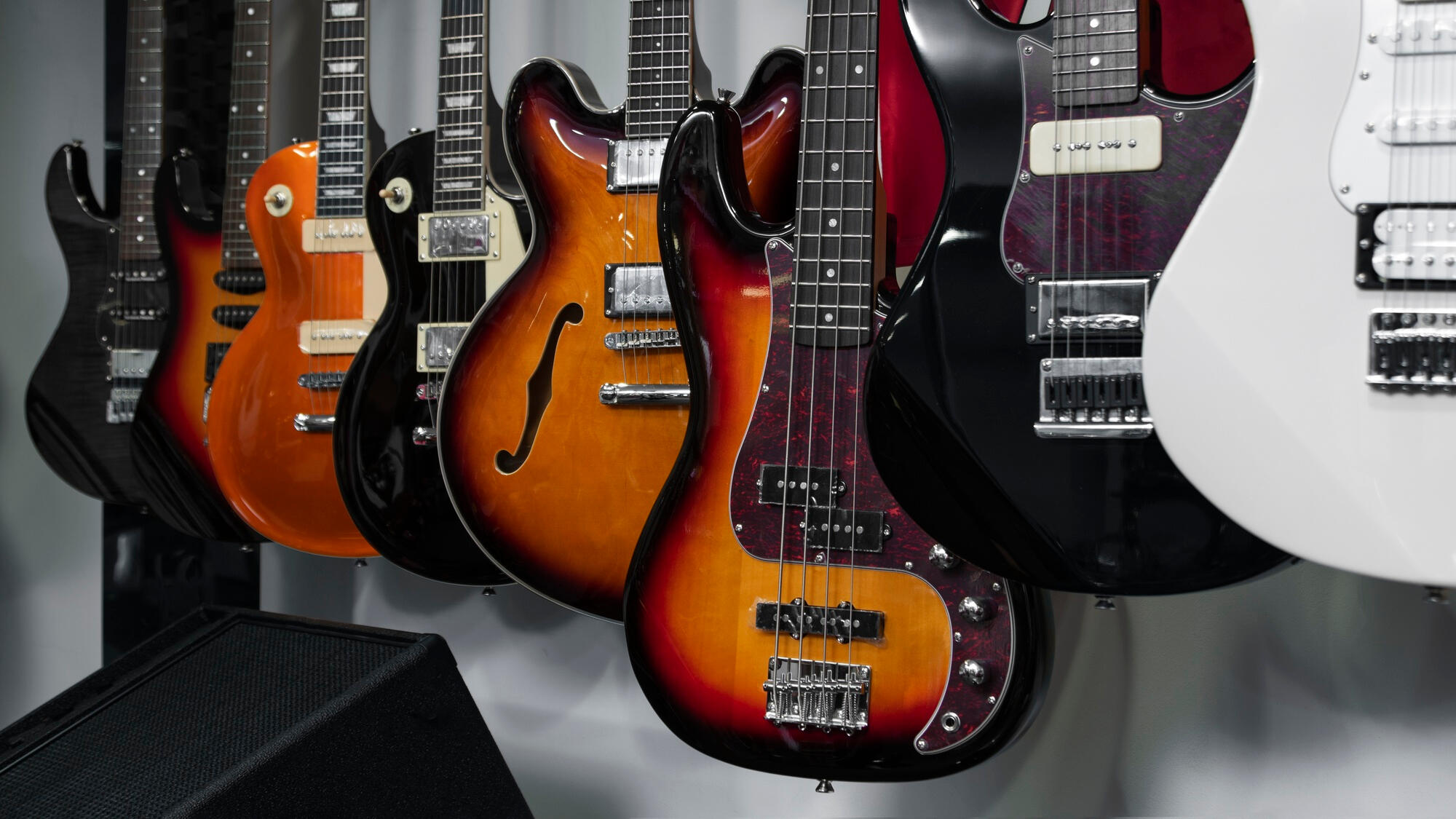
2️⃣Electric Guitars
Of all the different types of guitars, the electric guitar is probably the most common one used in modern music. These guitars are used for rock, blues, and jazz music. On their own, they produce a faint sound, but when connected to an amplifier, they produce beautiful music.1
Benefits
✅Smaller in size, which makes them easier to hold.
✅Ideal for players with small hands.
✅Used in modern music genres.
✅The amplifier helps create different music styles.
Here is how acoustic and electric guitars differ from each other.
Acoustic guitar
- Hollow wooden body
- Amplification not required
- Generally, a larger body
- Highly portable
- Cost is usually lower
- Suitable for unplugged sessions
Electric guitar
- Solid body
- Amplification required
- Generally, a smaller body
- Not so portable
- Cost is on the higher side
- Suitable for stage performances
Do you know about the differences between an acoustic and an electric guitar? They may look similar, but they have certain differences in how they look, the genres they are suitable for and the way they produce sound.
3️⃣Classical Guitars
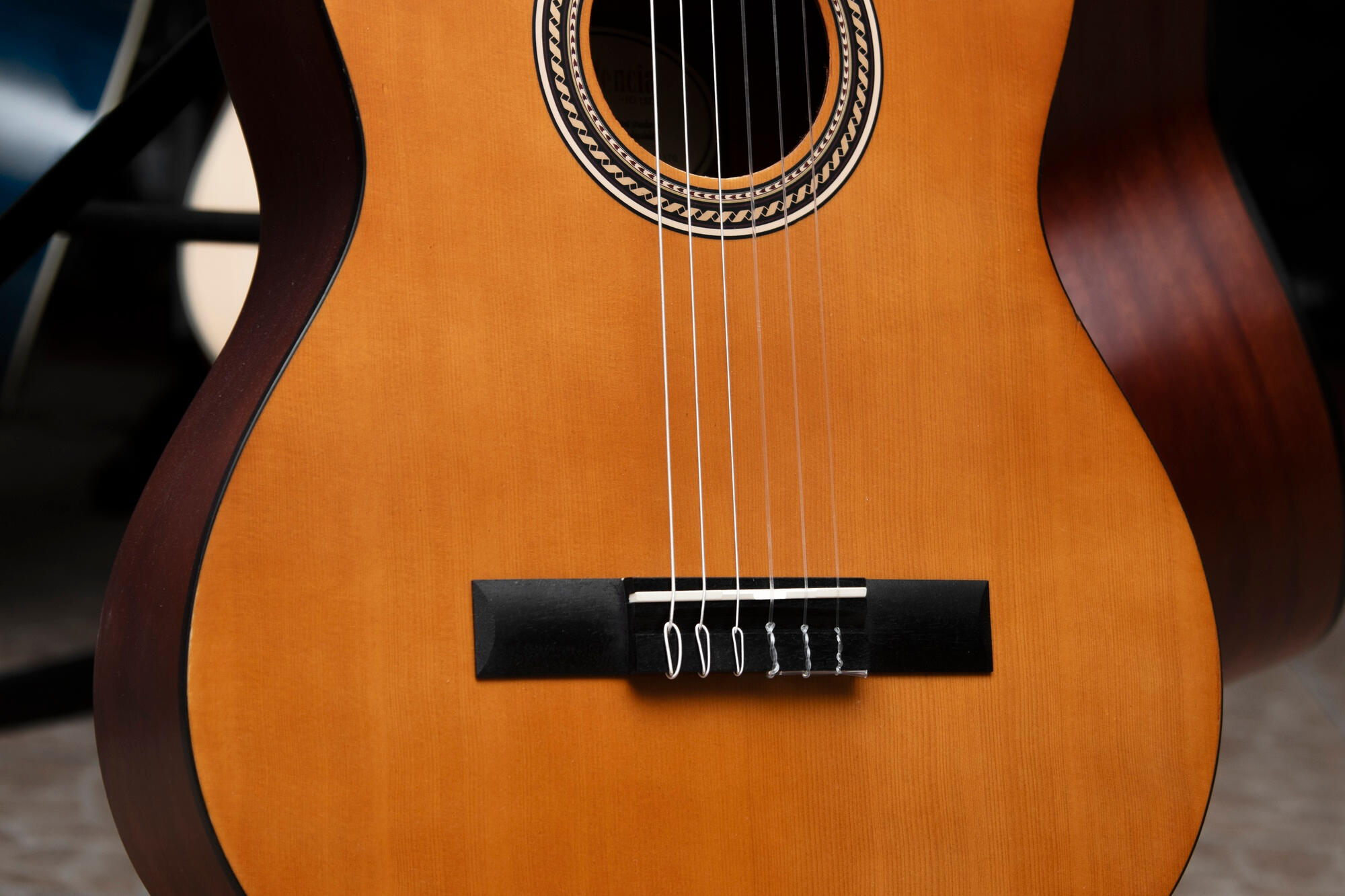
Classical guitars have nylon strings, smaller bodies and wider necks than acoustic guitars. They produce a softer tone that is perfect for classical and flamenco music. The wide neck of the guitar makes it ideal for accurate finger placement, which is ideal for playing complex tunes.
Benefits
✅Nylon strings make it easy on the fingers.
✅The soft, warm tones make it easy for classical and flamenco music.
✅Lightweight body.
✅Cheaper than both acoustic and electric guitars.
Since you have some basic understanding of what you are looking for, let us now look at some guitars you can consider as a beginner.
⚖️Factors to Consider When Choosing Your First Guitar
1️⃣Budget Considerations
How much should I spend on my first guitar is a question that every guitar enthusiast asks at some point for the other? When buying your first guitar, budget is an important consideration, as the price will usually affect the durability and playability of your first guitar. The very first thing you would need to do is get a guitar. Now comes the most critical yet complicated question you will encounter in your journey: How to choose the right guitar?
✅Guitars around S$200 or less might sit easy on your pocket and are one of the most affordable options for beginners. They are useful for learning chords and getting started with guitar basics. However, guitars in this price range have poor craftsmanship and have greater chances of wear and tear.
✅In the mid-range category (roughly S$300–S$1000), guitars are built better with good sound quality, tuning stability, and comfortable neck designs.
✅High-end guitars, which cost above S$1500, are crafted with premium materials. They deliver superior build quality, produce richer sound and will last for years.
Quality beginner guitars typically range from S$200 to S$600.
Intermediate guitars range from S$600–S$1,200+
Professional-level guitars range from S$1,200+ and above
Avoid buying extremely cheap guitars. Invest in a decent-quality and mid-range guitar for a better playing experience.
When buying a guitar, keep the following factors in mind:
2️⃣Playability and Comfort
Playability means how easy it is for you to play the guitar with best sound. A guitar with good playability feels comfortable to the hand and is easier to play. This makes learning more enjoyable and helps you play for extended sessions with your first instrument.
Follow the given tips to check the playability and comfort when choosing your first guitar:
Ideally, the neck should fit comfortably in your hand, letting you move naturally between chords and scales. Remember, a thin neck is not comfortable for large hands, while a thick neck might be uncomfortable for small hands.
Choose a guitar that has low action, where the strings are placed very close to the fretboard. This makes it easy to press the strings and play comfortably.
Larger guitar bodies can be difficult to hold for smaller-sized individuals. The shape will also determine how comfortably it sits on your lap.
Lighter strings are easier to play but do not produce the rich sound of heavier strings.
Fretboard: Ebony and rosewood are commonly used in fretboards. Maple can make the guitar stiff, so choose accordingly.
Ebony and rosewood are commonly used in fretboards. Maple can make the guitar stiff, so choose accordingly.
3️⃣Size and Shape
When it comes to choosing their first guitar, learners are often confused as to what size guitar to buy. The size and shape of your guitar play an important role in enhancing the playing experience, as the guitar will be more comfortable to hold and easier to control.
A simple rule of thumb to follow is:
📍Choose a half-size(1/2) or three-quarter(3/4) size guitar for players with a smaller build, kids or young adults. These guitars are lighter, easier to handle, and more comfortable for people with small hands or shorter arms.
📍Choose full-size guitars(4/4) if you are an adult. These guitars boast of superior quality, produce a more robust sound, and are meant to last.
Are you in a hurry? Here is a quick overview of the different guitar sizes and their features.
| Feature | 1/2-Size Guitar | 3/4-Size Guitar | Full-Size (4/4) Guitar |
|---|---|---|---|
| Size | Smallest, typically 30–34 inches long | Medium size, typically 36–38 inches long | Largest, typically 39–42 inches long |
| Comfort | Easy to hold and play for young children and small players | Comfortable for teenagers and smaller adults | Best suited for average-sized and taller adults |
| Weight | Very lightweight and easy to handle | Lightweight and comfortable to carry | Heavier due to the larger body |
| Sound | Softer volume with a smaller tonal range | Balanced tone with moderate projection | Fuller, richer tone with greater volume and projection |
| Playability | Short scale length and closely spaced frets make it easy for small hands | Comfortable fret spacing for growing players | Longer scale length requires greater finger stretch |
| Portability | Highly portable and easy to carry | Portable and travel-friendly | Less portable because of its larger size |

Rent or Buy?
When choosing your first guitar, you might be wondering whether to rent a guitar or buy one. There is no correct answer to this question. The right answer will depend on your budget, goals and the music you want to play.
Renting musical instruments in Singapore is a great option If you are still unsure if the guitar is the musical instrument for you or if you would like to learn the guitar but do not want to make an upfront investment. Businesses such as Sound Systems Rental and Accent Musical Equipment provide musical instruments on rent.
However, if you are passionate about learning the guitar, buying your guitar from a reputable shop is best. You will not go wrong with either option, but always remember that the cost of renting will eventually outweigh buying a new guitar, so it’s best to have a plan.
Where to Buy Your First Guitar in Singapore
If you have made up your mind that you want to buy a guitar instead of renting, then consider the following options.
🏪Local Guitar Shops
Buying from a physical store has its benefits, such as:
✅You can check out different guitar sizes
✅Have a feel of the guitar before choosing the right one for your needs
✅Get help from the staff in choosing the guitar based on your budget and style
The Guitar Shop Singapore
Although it was established only recently, the Guitar Shop has made a mark for itself as one of the most popular dedicated guitar stores in Singapore, featuring a wide range of acoustic, electric, and beginner guitars. Its highly knowledgeable and friendly staff can help with setup, tuning, and choosing the right size. The shop also provides maintenance and restoration services and sells pre-owned and vintage guitars.
Great store with excellent service. Bought my first OM from the the guitar shop, a TYMA TF-28 and it's been such a great guitar to play with for the past 4 years. Definitely a place I'll be coming by often to try new guitars.
Ryan Ashley, customer at The Guitar Shop
SageGuitar
Located in Primz Bizhub, Woodlands, Sage Guitar is another famous shop in Singapore that specialises in guitars and pre-packaged guitar bundles comprising of beginner-friendly guitars and guitar accessories.
Music Elements
Music Elements is a one-stop destination for all kinds of musical instruments. Backed by a knowledgeable team of experienced musicians and professionals with years of experience, they help customers make the right decision in choosing the perfect guitar. They also offer a repair centre and maintenance centre, ensuring your guitars stay in perfect condition.

🌐 Online Retailers
Online buying also works provided you:
✅Do your research properly on various models
✅Go through customer reviews
✅Compare prices and features across different stores
✅Note the return and exchange policy
✅Check the warranty coverage and after-sales support
Additional Accessories for Beginners
Similar to any other instrument, a guitarist needs a few essential tools to be successful. Here are the must-have essential accessories for guitar players.
Essential Accessories
- Strap: A guitar strap will keep your guitar steady and keep your hands free. It is especially required when you play the electric guitar.
- Hard case: A hard case is typically made of wood with a vinyl covering and plush material lining. A hard case is necessary if you plan to move around a bit with your acoustic guitar.
- Gig bag: A gig bag is a padded bag that is easy to carry around. These are less expensive than hard cases.
- Tuner: A guitar tuner will measure the pitch of your guitar string and keep it in tune.
- Picks: A guitar pick is a flat tool with which you strike the guitar strings.
- Spare strings: Guitar strings are subject to wear and tear, so it is always recommended to keep a pair of extra strings.
- Guitar cleaners: To keep your guitar looking fresh, keep a few cleaning accessories like polish and a microfiber cloth.
- Capo: A capo is a clamp that helps you play songs in different keys. It changes the pitch of the strings without requiring you to change your finger positioning.
- Metronome: A metronome is used to stay in tune and keep track of your speed.
🎶Learning to Play the Guitar
Self-Learning Resources
Thanks to the internet, like all instruments, learning the guitar by yourself has never been easier. With numerous resources available, you can learn to play the guitar from the comfort of your home.
YouTube
YouTube is one of the best channels out there to learn the guitar for free. It has thousands of lessons on guitar, right from beginner chords to advanced techniques.
A popular channel is Andy Guitar, which features a "10 Day Beginner Starter Course" and "14 Day Guitar Breakthrough Challenge", offering thousands of guitar lessons along with countless songs.
The channel features:
📍easy-to-follow lessons using beginner-friendly chords
📍audio tracks that help you practice strumming, rhythm, and playing in time
📍downloadable e-books, chord sheets and an interactive community
Another excellent channel is Marty Music, where you can learn the basics, such as chords and how to play entire songs. The site has 1000 plus free lessons that teach you the tips and techniques to learn the guitar. Once you are ready, you can sign up for premium lessons where you are taught in a structured manner.
Udemy

Udemy is one of the most popular online learning platforms, offering thousands of courses taught by skilled guitarists for all skill levels. They charge for their video lessons, but they are affordable.
While a lot of the courses are paid, most of them are available at affordable prices, making them valuable for beginners starting their journey of learning the guitar.
Apart from the paid courses, Udemy also offers free courses to help you learn the guitar. One of the highest-rated free courses online is by Lesson Pros. Their strumming guitar course is suitable for those who have no skills when it comes to the guitar. On top of learning to strum, you will also learn rhythm, basic chords, and fundamental guitar skills.
Are you interested in learning more about other guitars? Explore our other online resources on guitars to understand the basics, the differences, and everything else you need to know about guitars.
Finding a Guitar Teacher in Singapore
As discussed in the previous section, many resources are available online for those interested in self-learning the guitar. What about hiring a tutor? One of the best things you can do when learning the guitar is to hire a tutor.2 Yes, they cost money, but they are well spent. There are so many benefits to taking guitar lessons from a tutor, which we have listed below.
Individual Attention
One of the best parts about hiring a tutor is the individual attention and feedback you get. Just like any other instrument, learning the correct basics for the guitar is essential. One of the most common issues faced by people who self-teach themselves the guitar is that they learn the basics incorrectly. This is bad and a waste of time, as they had to relearn the basics, which was difficult.
Alberto is the best! Super cool teacher. I've been under his wing for 5 years and never have i wondered in giving up guitar. He is very friendly, flexible and a super nice guy! if you want to have fun while learning guitar, you must take classes with Alberto!
Marcos, student on Superprof
Feedback
One of the most valuable aspects of hiring a tutor is the feedback you get. A tutor will not only be able to guide you as you embark on your journey of learning the guitar, but also provide you with valuable feedback, which will not only make you a better guitarist but also help you grow as a musician.
Keep You Motivated
Most people who self-learn the guitar tend to give it up within a year. The main reason is that they feel learning this instrument is not only tricky but boring. This is where a tutor comes in. A tutor can tailor their lessons for you and keep them exciting and fun.
Superprof is one of the places where you can find tutors to help you learn the guitar. The tutors from Superprof are not only qualified, experienced, and knowledgeable but also verified. Not only do they have the experience to guide you, but they can also help you achieve the highest standard possible.
🛠️Maintaining Your Guitar
Regular Maintenance
- Maintain humidity: A solid wood guitar is more vulnerable to humidity changes. Store your guitar in an environment with around 40 to 60% relative humidity. This will prevent the wood from drying out and forming cracks.
- Clean regularly: Regularly wipe your guitar with a soft microfiber cloth to keep it clean and free of dirt and fingerprints.
- Condition your fretboards: Periodically condition your fretboard with a fretboard conditioner. This will keep it smooth and moisturised.
- Store in a case: Protect your guitar from dust and other damage by storing it in a case or gig bag to keep it safe.
- Change strings: If you are a regular performer, replace your strings every 2 to 3 months. To make your strings last longer, consider buying coated strings that provide more protection against dirt and grime.
I wipe my strings down every time I put the guitar down between sets on gigs or after each practice session in the woodshed. I used to use rubbing alcohol and a soft cloth, but now I use John Pearse String Swipes.
Paul Mehling, Hot Club of San Francisco
Professional Setups
Even with regular care at home, your guitar needs to be checked by a professional at least once a year. Professional guitar technicians follow a detailed process called a "setup" to ensure your guitar stays in perfect working condition.
During the checkup, the professional will check:
✅the neck joint for cracks
✅the truss rod and intonation to ensure it is in tune
✅for uneven or worn frets
✅tone knobs and volume
✅input jacks and knobs to ensure they are not loose
Buying a guitar for the first time can be an exciting thing. Ultimately, choosing your first guitar should depend on your playing goals, your budget, and personal preferences. A good quality electric or acoustic guitar coupled with regular practice and support of a tutor can make the learning process more enjoyable.
References
- Genani, G., Dekker, M., & Molenbroek, J. (2013). Design of an ergonomic electric guitar. Research Repository (Delft University of Technology). http://resolver.tudelft.nl/uuid:913d9ce8-4a22-471d-8adf-311937698992
- Ceviz, B. (2023). Activity-Based Fundamental Music Theory instruction in amateur guitar education. Shanlax International Journal of Education, 12(1), 59–69. https://doi.org/10.34293/education.v12i1.6714
Summarise with AI:
Did you like this article? Leave a rating!

 Loading...