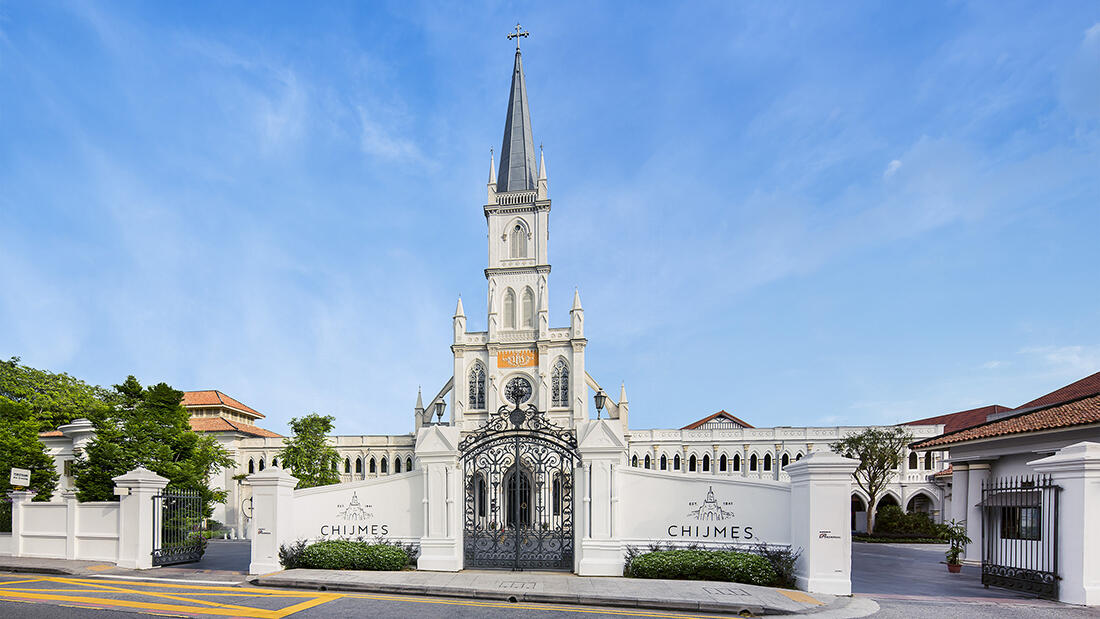

What makes colonial buildings in Singapore worth exploring? Beyond the modern skyline of Marina Bay and its tall skyscrapers, these historic landmarks preserve a visible record of British colonial rule, trade, administration and events during the Japanese Occupation.
Many of these landmarks are concentrated around the Civic District, the Singapore River and Bras Basah, although important examples can also be found in Orchard Road, Kampong Glam and other districts. Their architectural styles, from neoclassical façades to ornate details, reflect Singapore’s changing history and development.
Today, many are gazetted as National Monuments, while others have been adapted into museums, art venues and hotels. These colonial buildings in Singapore showcase remarkable craftsmanship while reminding us of a complex past shaped by colonial power, trade and social hierarchy.
| Building | Original purpose or historical role | Current use |
|---|---|---|
| The Arts House | Former residence, courthouse and Parliament House | Arts and literary venue |
| Former City Hall | Civic administration; site of the 1945 Japanese surrender ceremony in Singapore | Part of National Gallery Singapore |
| Former Supreme Court | Singapore's highest court during the colonial era | Part of National Gallery Singapore |
| Victoria Theatre and Concert Hall | Public hall and memorial hall | Performance venue |
| St Andrew’s Cathedral | Anglican cathedral | Active place of worship |
| Old Hill Street Police Station | Police station and barracks | Government offices |
| Raffles Hotel | Colonial-era hotel opened in 1887 | Luxury hotel |
| The Fullerton Building | General Post Office and government offices | The Fullerton Hotel Singapore |


🏛️What Defines Colonial Architecture in Singapore?
The colonial period and Singapore’s built heritage
Colonial architecture in Singapore developed during British rule, following the establishment of a British trading settlement in 1819. Construction accelerated throughout the 19th and early 20th centuries as the port grew and the city became an important centre for regional trade.
Government offices, courts, churches, schools, hotels and commercial premises reflected European architectural styles and the priorities of colonial administration and the economy.
Many of these structures survive today because of their design, civic and cultural value. Some retain their original functions, while others have been adapted into museums, galleries and arts venues, such as National Gallery Singapore, which occupies the former City Hall and Supreme Court buildings. Their continued presence offers a glimpse into how the city was governed and how its urban landscape evolved.
Common architectural features
Colonial architecture in Singapore includes several styles, each with its own distinctive features. Neoclassical structures often have symmetrical façades, columns, porticos (covered entrances supported by columns) and pediments (triangular structures above entrances). Palladian and Renaissance-inspired designs can also be seen in civic landmarks.
Other structures feature arched windows, verandahs, high ceilings and large louvred windows that encourage airflow in the tropical climate. Courtyards and covered walkways offer shade and shelter from heavy rain.
However, colonial-era structures were never a single style. Later developments incorporated Indo-Saracenic influences, while Art Deco introduced geometric shapes and streamlined forms. Architects also adapted imported ideas to local materials, weather conditions and the city's multicultural setting.
Architectural features to look for
Columns and porticos
Look for these at Victoria Theatre and Concert Hall, where classical design lends the façade a formal, civic character.
Arched windows and verandahs
Notice the traditional details on historic buildings such as The Arts House, formerly the Old Parliament House.
Conservation note
A National Monument designation recognises a place of national significance and provides legal protection for its heritage value. Conserved buildings that are not National Monuments can also contribute to the city's architectural character.
🏢The Essential Colonial Buildings in Singapore’s Civic District
The Civic District is one of the best places to explore Singapore's colonial architecture on foot. Its former government offices, courts, cultural venues and religious buildings reveal how British administration shaped the city.
Their present-day uses show how strict heritage conservation laws help protect these historic structures.
The Arts House: Singapore’s former Parliament building
Originally constructed between 1826 and 1827 as a private residence for Scottish merchant John A. Maxwell, the structure now known as The Arts House is believed to be the country’s oldest surviving building. Designed by George D. Coleman, it was intended to be Maxwell’s home but was instead leased to the British administration for use as a courthouse and government offices1.
Over the years, the property took on several roles. It housed courtrooms and government departments before becoming the Legislative Assembly House and later the Parliament House. Parliament moved out in 1999, and the building was subsequently adapted into an arts and heritage venue.
Its design has also changed over time. The original design was Neo-Palladian, but successive renovations altered many of its features. Today, its Neoclassical appearance includes triangular pediments, Corinthian pilasters and a Palladian window on the front façade. Loggias also help shield the structure from the tropical heat.
Today, it serves as a venue for exhibitions, performances and literary events, including events associated with the Singapore Writers Festival. It offers visitors a chance to experience a historic civic landmark that has taken a different role in the country’s creative scene.
Before visiting, check their official website for current exhibitions, festivals and public events, as access may depend on the programme.
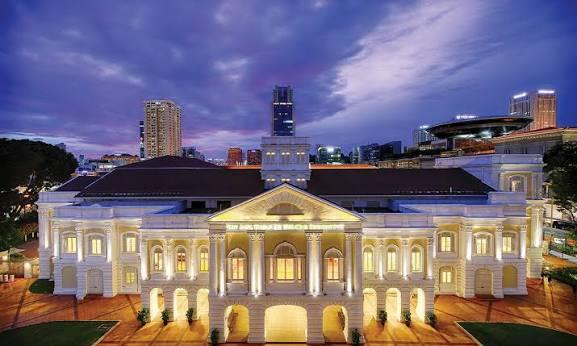
Former City Hall and the Former Supreme Court at National Gallery Singapore
The former City Hall, originally known as the Municipal Building, was completed in 1929 to house municipal offices. It later became the setting for several important moments in the nation’s history. On 12 September 1945, Admiral Lord Louis Mountbatten accepted the Japanese forces’ surrender in the building’s chamber on behalf of the Allied forces, marking the end of the Japanese Occupation in Singapore2.
One of the most striking features is its front façade, which faces the Padang and is flanked by 18 three-storey-high Corinthian columns. These give it an imposing, formal appearance.
Beside it stands the former Supreme Court, which opened in 1939 and served as Singapore’s highest court until 2005. Designed by Frank Dorrington Ward, it is regarded as the last major Neoclassical building constructed in colonial Singapore. Its four blocks surround a central rotunda topped by a dome, which originally housed a circular law library. During the Japanese Occupation, it was known as Syonan Kotohoin, or Syonan Supreme Court.
Together, the two landmarks now form National Gallery Singapore, which contains a major collection of modern and contemporary art from Singapore and Southeast Asia.
Adaptive reuse means giving a historic structure another purpose while retaining its important features and heritage character. It allows older structures to remain useful and relevant as the city evolves.
Their transformation into an art museum is an example of adaptive reuse: instead of demolishing the historic structures, they were restored and given another purpose while retaining significant architectural features.
Allow at least two hours to explore the galleries. Check the National Gallery Singapore website for current opening hours, admission details and special exhibitions, particularly around public holidays.
Victoria Theatre and Concert Hall
Victoria Theatre began as the Town Hall, which was constructed between 1855 and 1862. It provided space for public gatherings, performances and municipal offices. Following Queen Victoria’s death in 1901, plans were made to build a memorial hall beside it. The Victoria Memorial Hall was completed in 1905, and a clock tower was added to connect the two buildings3.
The Town Hall was later remodelled into a theatre, with its façade redesigned to match the adjoining memorial hall. The renovation was completed in 1909, and the building became known as Victoria Theatre. The memorial hall was renamed Victoria Concert Hall in 1979, although the name Victoria Memorial Hall can still be seen on its façade.
The complex underwent major renovation works between 2010 and 2014. The project upgraded the performance facilities and restored features that had been lost over the years. These included a reinterpretation of Queen Victoria’s crown atop the clock tower and the opening up of the passageway between the two buildings as an atrium and event space.
Today, Victoria Theatre and Victoria Concert Hall remain active venues for theatre productions, concerts and other cultural events. The complex is also home to the Singapore Symphony Orchestra. Even if you do not attend a performance, its clock tower and classical features make it a worthwhile stop on a walking route through the Civic District. Check the official website for performance schedules and visitor information.
St Andrew’s Cathedral
With its white exterior, pointed arches and tall spire, St Andrew’s Cathedral stands apart from the Neoclassical civic buildings nearby. It is one of Singapore’s most prominent religious landmarks and a notable example of Neo-Gothic architecture4.
This National Monument stands at the northern corner of the Padang, along St Andrew’s Road, in Singapore’s historic Civic District.
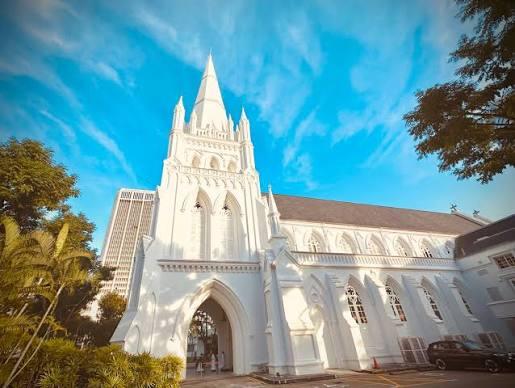
The present building was designed by Lieutenant-Colonel Ronald MacPherson after the earlier church on the site was struck by lightning twice and declared unsafe. The church held its first service in 1861 and was consecrated in 1862. It became a cathedral in 1870.
Indian convict labourers played a major role in constructing the cathedral, under the supervision of colonial officials. During the Japanese Occupation, it continued to hold services for much of the period. Its nave was also temporarily used as an emergency hospital for casualties during the invasion.
Visitors should dress respectfully and check visiting hours before arriving, especially around worship services and special events.
🏨Other Singapore Colonial Buildings Worth Seeing
Beyond the Civic District, several other colonial-era landmarks offer a broader picture of how architecture, trade and public life developed across Singapore.
They are easy to combine with visits to the Singapore River, shopping districts and nearby heritage areas.
Old Hill Street Police Station
Constructed in 1934, the Old Hill Street Police Station originally housed the Hill Street Police Station and Barracks. It was the largest government building in Singapore at the time of its completion and provided accommodation and facilities for police officers and their families. It was gazetted as a National Monument in 19985.
Later, it became the home of government agencies, including the Ministry of Information, Communications and the Arts, which led to its former name, the MICA Building. It now accommodates the Ministry of Digital Development and Information and the Ministry of Culture, Community and Youth
Its most recognisable feature is its colourful façade, with 927 windows painted in the colours of the rainbow. The rows of shutters and balconies give it a distinctive appearance among Singapore’s historic landmarks.
During the Japanese Occupation, the place was painted brown to camouflage it against Allied air attacks. After the war, it was repainted white in 1949. A major renovation in 1999 added a glass roof over the central courtyard, creating an atrium that could accommodate exhibitions and art installations.
Photography tip: Stand across Hill Street to capture the colourful windows across the full façade. Its location near Clarke Quay, the Singapore River and Fort Canning also makes it an easy addition to a heritage walk.
As government ministries are still based there, visitors should admire the exterior rather than assume that the offices, upper floors or atrium are open to the public.
Raffles Hotel and colonial-era hospitality
Opened on 1 December 1887, Raffles Hotel Singapore is one of the city’s best-known historic landmarks. The site originally had a beachside residence that was later converted into Emmerson’s Hotel. The Armenian Sarkies brothers took over the property and established Raffles, which grew into a prominent destination for international guests6.
The hotel expanded over the following years. Its main building, completed in 1899, was designed by Regent Alfred John Bidwell of the architectural firm Swan & Maclaren. High ceilings, generous verandahs and classical details helped create an elegant setting suited to the island’s tropical climate.
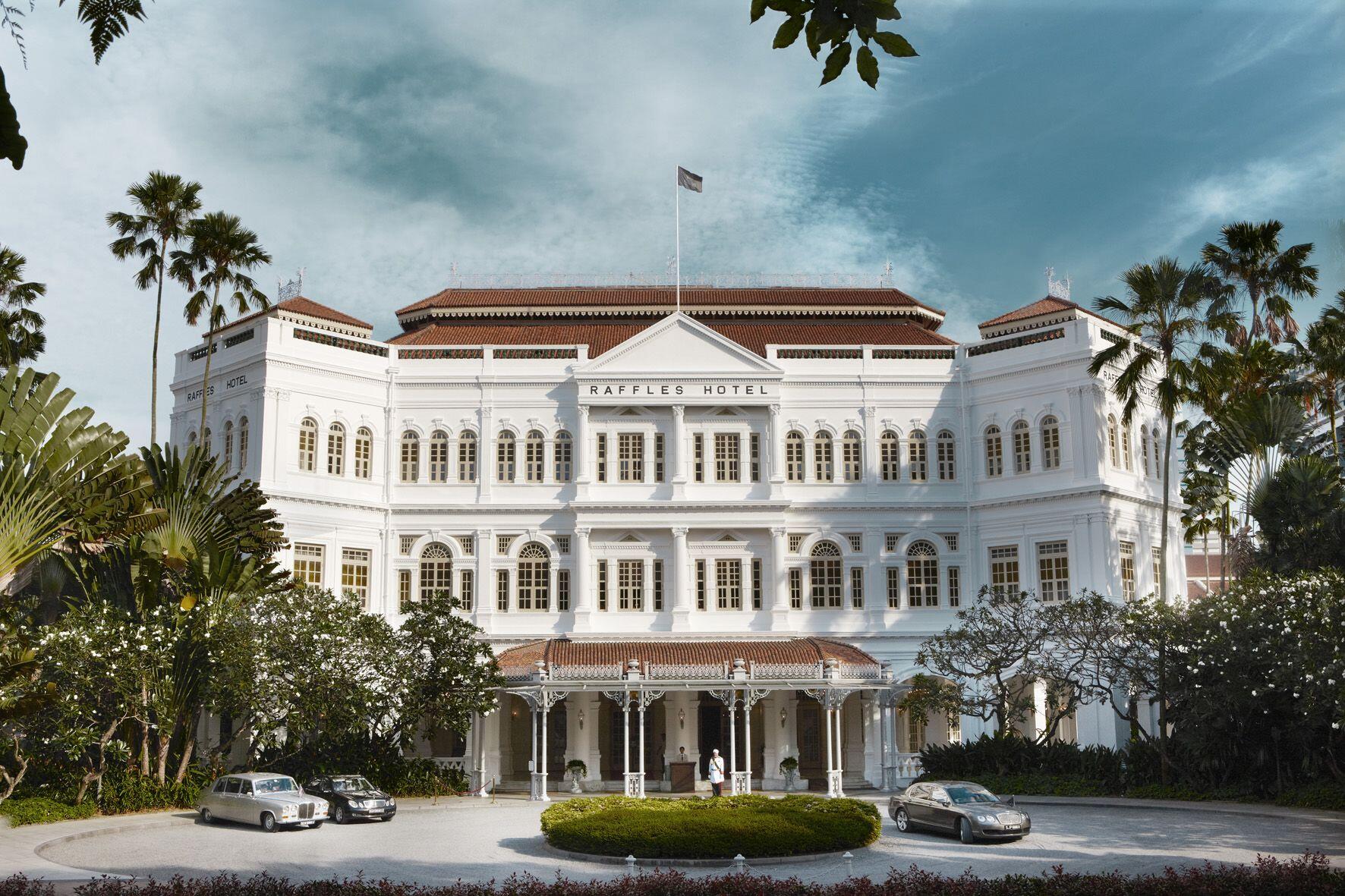
Beyond its architecture, the structure offers a glimpse into the nation’s history as a regional trading and travel hub. Its guests included writers, performers and other prominent visitors, while its continued operation reflects the changing role of luxury hospitality in the city.
Raffles Hotel was first gazetted as a National Monument in 1987 and was gazetted again in 1995.
You do not have to stay overnight to appreciate its exterior and arcade. Selected dining venues and heritage spaces may also be accessible, subject to the hotel’s arrangements. Check their official website before planning a visit.
The Fullerton Building and Singapore River landmarks
Completed in 1928, the Fullerton Building originally served as the General Post Office, alongside several government departments and business organisations. Its position near the mouth of the Singapore River reflected the area’s importance as a centre for trade, communications and administration.
One of its most striking features is its imposing two-storey Doric colonnade, which gives the Neoclassical façade a grand, formal appearance. Its role in trade and postal communications reflected Singapore’s importance during British rule.
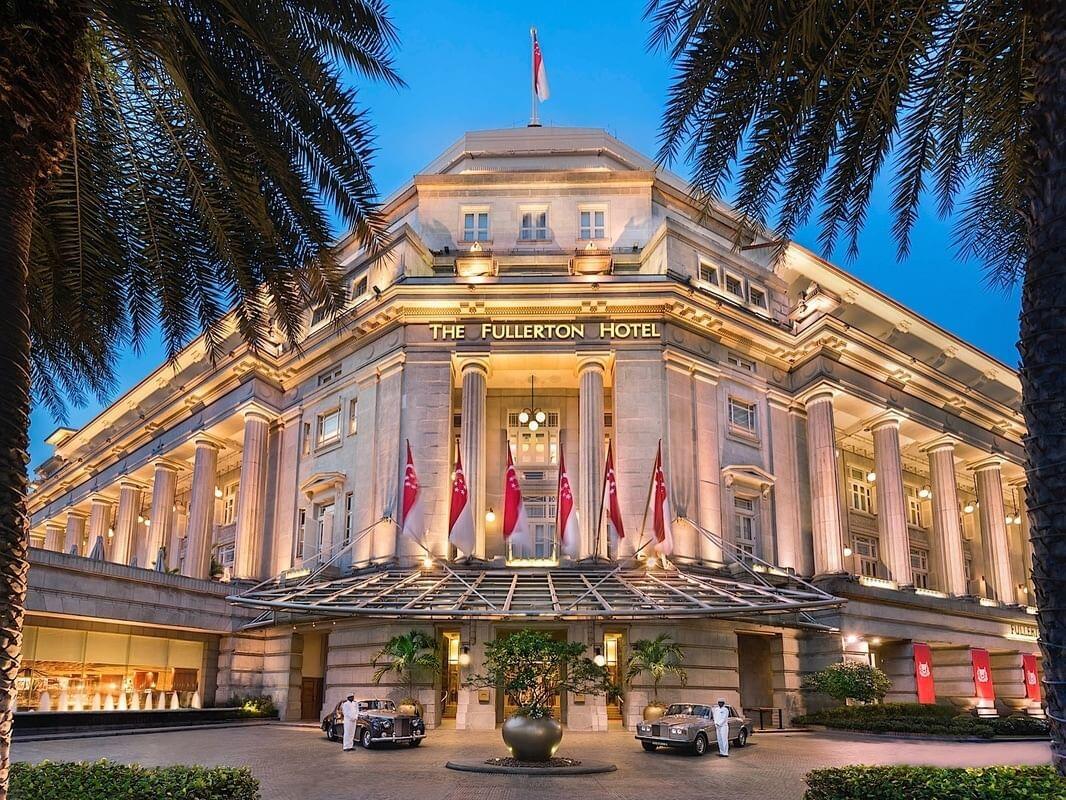
After the war, the structure continued to be used by government departments. Following redevelopment, it reopened as The Fullerton Hotel Singapore in 2001. It was gazetted as a National Monument in 2015. Its transformation from a major postal and government facility into a hotel is another example of how Singapore has adapted historic structures for modern use.
For a longer walk, continue towards the nearby Asian Civilisations Museum, located in the former Empress Place Building. Its exhibitions explore the cultural connections between Singapore and other Asian regions, offering additional context for understanding the region’s trading networks and multicultural heritage.
Swan & Maclaren is one of Singapore’s oldest architectural firms. The partnership was formed in 1892, building on an earlier practice established by Archibald Swan and Alfred Lermit in 1887. Its work includes the main building of Raffles Hotel and Victoria Memorial Hall, now Victoria Concert Hall. The firm’s projects reflect the variety of architectural styles that shaped Singapore during the colonial period.
🚶🏽♀️➡️A Self-Guided Colonial Architecture Walk in Singapore
Suggested 2–3-hour heritage route
Explore the city's colonial past on foot with this route through historic civic buildings, diverse religious landmarks and the Singapore River waterfront. Allow extra time if you plan to visit museum galleries or attend an exhibition.
7 landmarks | Approximately 2 km | 2–3 hours
- National Gallery Singapore – Explore the former City Hall and Supreme Court, now home to Singaporean and Southeast Asian art.
- St Andrew’s Cathedral – Admire its white Gothic Revival architecture and distinctive spire.
- The Arts House – Discover the former Parliament House, now an arts and literary venue.
- Victoria Theatre and Concert Hall – See the historic performance complex and its recognisable clock tower.
- Asian Civilisations Museum and Empress Place – Explore the riverfront and its colonial-era civic architecture.
- The Fullerton – Admire the former General Post Office, now The Fullerton Hotel Singapore.
- Old Hill Street Police Station (optional extension) – Photograph its colourful window shutters before continuing towards Clarke Quay or Fort Canning.
Practical visitor advice
Morning or late afternoon is generally more comfortable for walking in Singapore's heat and humidity. Wear comfortable shoes and bring water, particularly if you plan to explore the waterfront.
City Hall and Raffles Place MRT stations are convenient for the central route, while Clarke Quay and Fort Canning stations may suit the optional extension.
Some places are working institutions, places of worship or ticketed attractions, so access varies. Check official websites for opening hours, admission requirements, security arrangements and event closures before setting off.
The history of a city is recorded not only in books, but also in its buildings.
S. Rajaratnam, former Deputy Prime Minister of Singapore (1980–1985).
🏝️Why Singapore Continues to Conserve Colonial-Era Buildings
Conserving colonial-era buildings allows Singapore to preserve a tangible record of its urban development. Their architecture reflects how the city was governed, how trade shaped its growth and how local communities experienced different periods of its history.
Many of these structures have taken on different roles through adaptive reuse. The former City Hall and Supreme Court now house National Gallery Singapore, while the Old Parliament House operates as The Arts House. The former General Post Office has become The Fullerton Hotel Singapore, and the Old Hill Street Police Station accommodates government-related offices.
These transformations allow historic structures to support the arts, education, hospitality and tourism while remaining part of our everyday city life.
However, appreciating colonial architecture also means looking beyond its craftsmanship. These structures reflect a complex past shaped by empire, migration, commerce, governance and social hierarchy. Understanding these wider histories helps us recognise the contributions of different communities without romanticising colonial rule.
From the grand civic landmarks around the Padang to the colourful windows of Old Hill Street Police Station, the city’s colonial-era heritage reveals a different side of its past. Explore its famous bridges and their historical significance to discover how these structures connect heritage sites, waterways and neighbourhoods across the urban landscape.
References
- NLB. (n.d.-aa). Retrieved October 9, 2026, from https://www.nlb.gov.sg/main/article-detail?cmsuuid=533c455c-bde9-406c-9962-03bf87296ab8
- NATIONAL GALLERY SINGAPORE. (n.d.-b). Our Architecture & History | National Gallery Singapore. National Gallery Singapore. https://www.nationalgallery.sg/sg/en/architecture-and-history.html
- Roots.sg. (n.d.-c). Retrieved October 9, 2026, from https://www.roots.gov.sg/places/places-landing/places/national-monuments/victoria-theatre-and-concert-hall
- NLB. (n.d.-ab). Retrieved October 9, 2026, from https://www.nlb.gov.sg/main/article-detail?cmsuuid=69d540ff-b1a1-4a62-8a5a-800404326ace
- NLB. (n.d.-ac). Retrieved October 9, 2026, from https://www.nlb.gov.sg/main/article-detail?cmsuuid=cf4118c4-088b-4a20-922c-6a64c90e8dbe
- NLB. (n.d.-ad). Retrieved October 9, 2026, from https://www.nlb.gov.sg/main/article-detail?cmsuuid=626de813-59c0-47a3-8f5d-b4e8bdea2196
Summarise with AI:
Did you like this article? Leave a rating!

 Loading...