
What are the famous bridges in Singapore, and what stories do they tell about a river port becoming a modern city? From the Singapore River to Marina Bay, these crossings reflect the transformation of a trading port into a global city.
Historic Singapore River bridges connect areas such as Boat Quay, Clarke Quay and the Civic District, while newer landmarks like Helix Bridge have become part of the modern skyline.
This guide explores the famous bridges in Singapore, from historic crossings built for a growing port to modern bridges that reflect the country’s development into a global commercial hub. You’ll discover what makes each bridge memorable and how to see several of them along one walk.
| Bridge | What makes it famous? | Location / Nearby area |
|---|---|---|
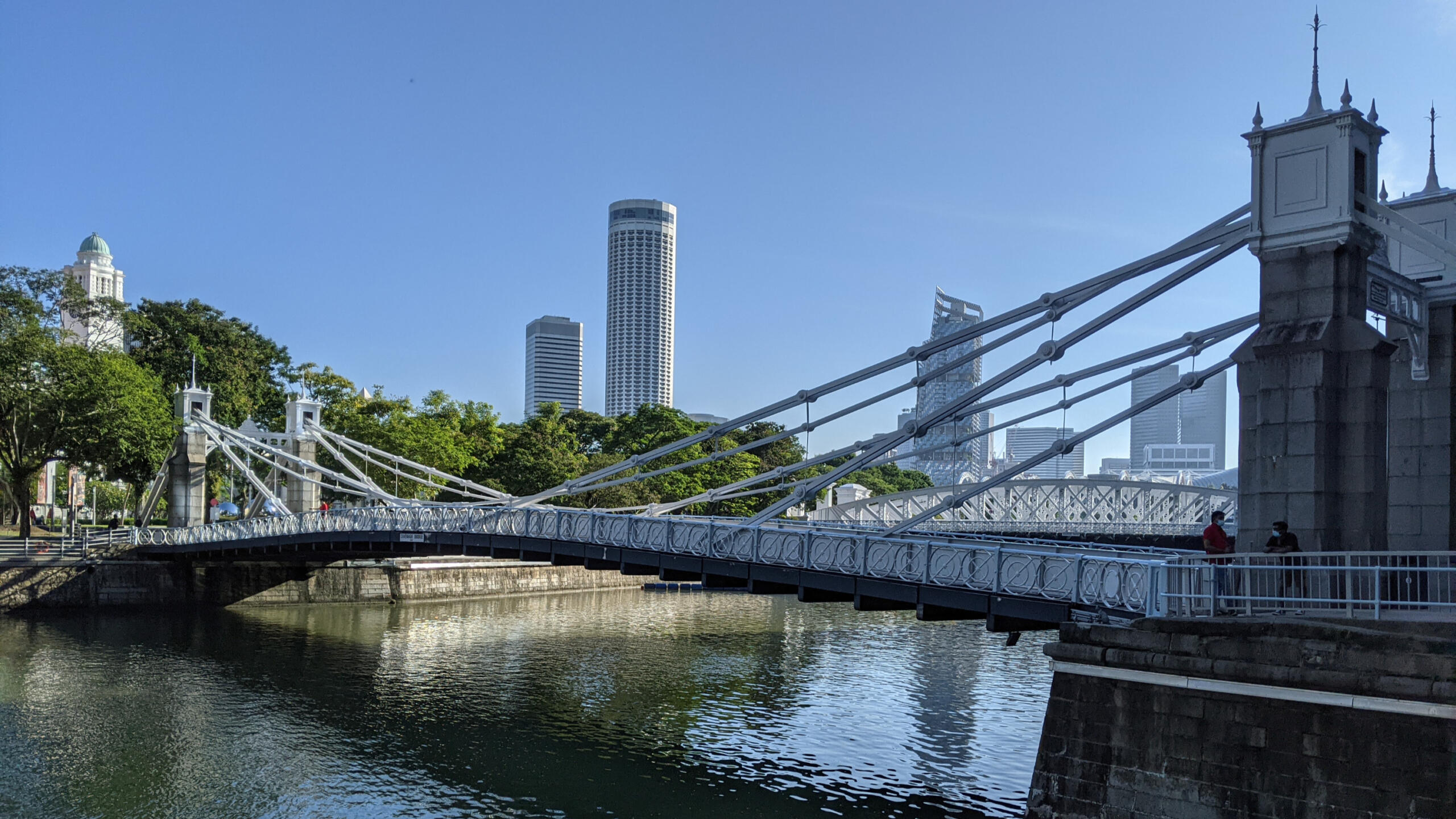
| Cavenagh Bridge | Historic pedestrian bridge dating from 1869 | Fullerton precinct |
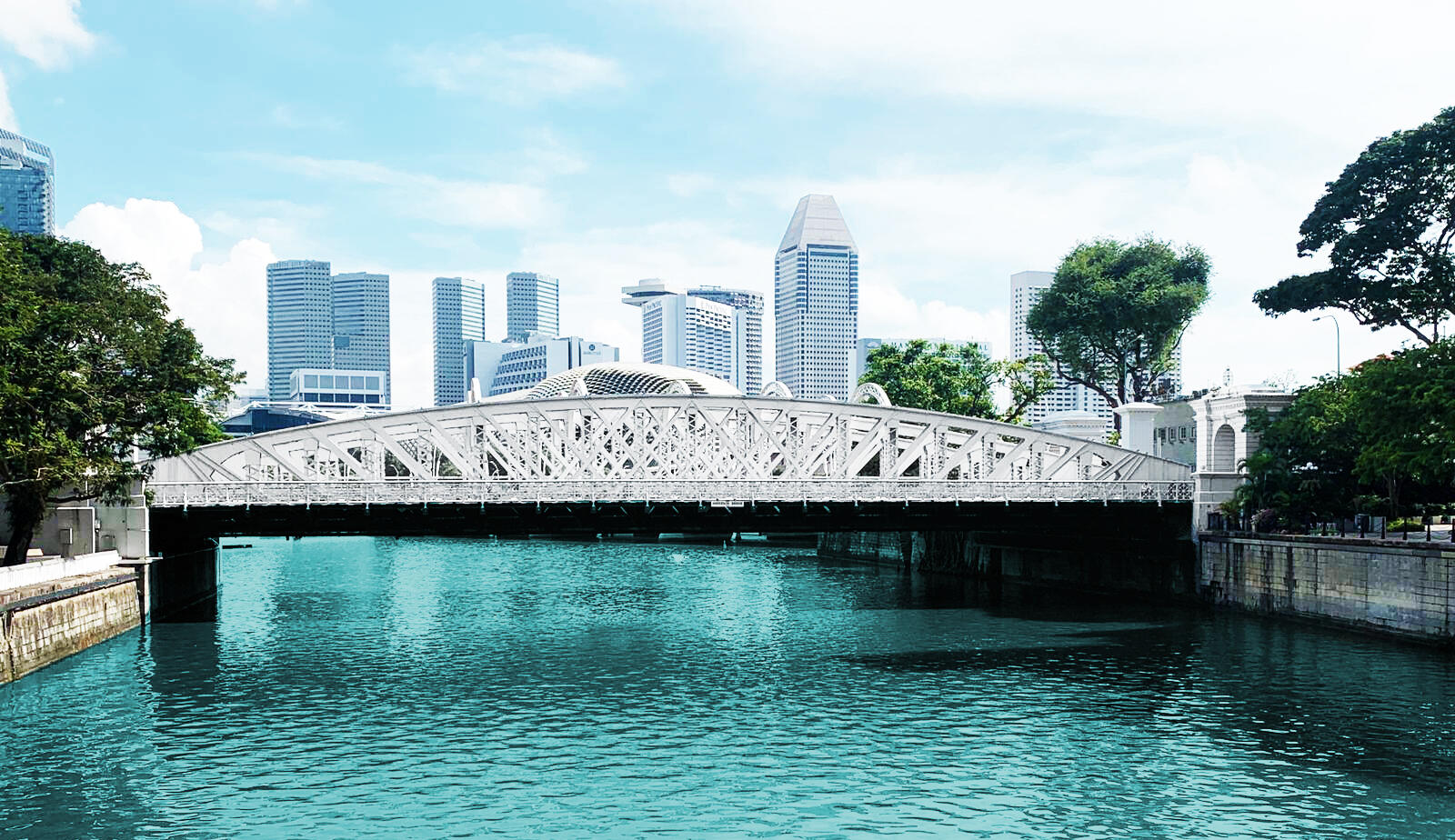
| Anderson Bridge | Steel arches and colonial-era architecture | Civic District |
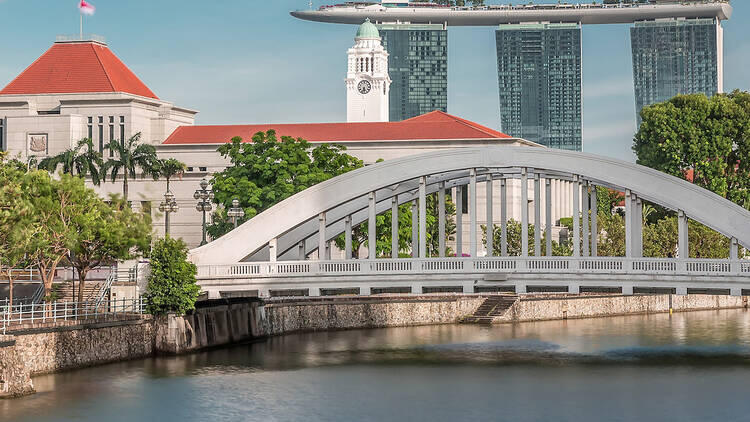
| Elgin Bridge | Historic river crossing with decorative lamps | Boat Quay |
| Read Bridge | Connection to the river’s trading and social history | Clarke Quay |
| Coleman Bridge | Historic crossing near early civic and commercial areas | New Bridge Road |
| Helix Bridge | Double-helix design and striking night views | Marina Bay |
| Alkaff Bridge | Colourful painted design and riverside setting | Robertson Quay |


🏞️Why Singapore’s Bridges Matter: From River Trade to City Landmarks
The Singapore River played an important role in the country’s early trade. Boats carried goods between larger vessels offshore and the warehouses, godowns and trading houses along its banks.
When the British established Singapore as a free port in 1819, activity along the river increased. As trade and development grew, bridges became important connections between the north and south banks, linking commercial areas, civic buildings, warehouses and residential districts.
Today, the Singapore River precinct combines historic landmarks and heritage sites with dining areas, museums, hotels and public spaces. Many historic bridges remain active road or pedestrian crossings, while their distinctive structures also make them popular photography spots.
Historic bridges such as Cavenagh, Anderson and Elgin reflect colonial-era trade and civic development, while modern landmarks such as Helix Bridge serve as architectural attractions and walking links around Marina Bay.
Many of these historic bridges are located close together along the Singapore River, making it easy to explore several on foot while taking in the surrounding shophouses, conserved buildings and waterfront spaces. Their use of steel, iron and concrete also reflects the changing needs of a growing port.
🌉Historic Singapore River Bridges You Should See
The Singapore River bridges offer some of the clearest glimpses into the country’s development as a trading port. Three of them, Cavenagh, Anderson and Elgin, are National Monuments, while Read and Coleman bridges add further stories about trade, transport and communities along its banks.
You can easily explore all of them on a single walk. These historic structures are located close to one another, with historic landmarks, waterfront views, and plenty of places to grab a drink or bite to eat along the way.
Cavenagh Bridge: Singapore’s Oldest Bridge Across the River
Opened in 1869, Cavenagh Bridge is the oldest bridge spanning the Singapore River that survives in its original form. It was named after Sir William Orfeur Cavenagh, the last colonial Governor of the Straits Settlements. It was constructed by Indian convict labourers1.
It spans the lower reaches of the Singapore River, connecting the Civic District (Empress Place) to the Commercial District (Raffles Place / Fullerton Square). Cavenagh Bridge was gazetted as a National Monument in 2019, together with Anderson and Elgin Bridges.
Cavenagh Bridge opened in 1869, and its original traffic notices are still displayed at both ends.
Its elegant suspension design, cast-iron structure and decorative details give it a distinctive appearance. Look closely, and you can still see the historic notices restricting cattle, horses and vehicles weighing more than 3 cwt, or about 152kg.
These signs reflect a time when pedestrians, carts and livestock were a common sight on the city’s streets.
Today, Cavenagh Bridge is pedestrian-only and makes an easy first stop near the Fullerton precinct and Asian Civilisations Museum. Raffles Place MRT is the nearest station. For photographs, walk onto the river promenade and frame the bridge with the Fullerton building or the waterfront skyline.
Anderson Bridge Singapore: A Grand Civic-District Crossing
Anderson Bridge was completed in 1909 and officially opened in 1910, mainly to relieve the growing traffic on Cavenagh Bridge. Its location between Empress Place and Collyer Quay placed it at an important meeting point between the Civic District and the commercial waterfront2.
It was named after Sir John Anderson, who served as Governor of the Straits Settlements and High Commissioner for the Federated Malay States from 1904 to 1911. Anderson Bridge was gazetted as a National Monument in 2019.
The structural steelwork was manufactured in Britain and shipped to Singapore, while the stone bearing the names of those involved in the bridge’s construction was imported from Aswan, Egypt. Other parts, including the railings, castings, rainwater channels and gully frames and covers, were produced locally.
It also serves as a famous, scenic part of the Marina Bay Street Circuit for the annual Singapore Grand Prix.
Today, it remains an active road crossing, with pedestrian paths alongside the carriageway. Raffles Place MRT and City Hall MRT are convenient starting points. For the best atmosphere, visit around blue hour and photograph its sweeping lines from the river promenade or Cavenagh Bridge.
Elgin Bridge: The Historic Link Between North and South Singapore
Elgin Bridge connects North Bridge Road and South Bridge Road, near the historic heart of the river precinct. It was named after Lord James Bruce Elgin, the eighth Earl of Elgin and Governor-General of India from 1862 to 18633.
The present structure opened in 1929, but the site has a much longer history. A wooden footbridge was erected here in the 1820s, and the present bridge is the fifth structure to occupy the site.
The current bridge is a reinforced-concrete bowstring-arch bridge with three arches. Its steel arches are encased in concrete, while the cast-iron lamps and decorative medallions were designed by Italian sculptor Rodolfo Nolli.
Clarke Quay MRT is a convenient starting point, although Raffles Place MRT or City Hall MRT can work depending on your walking route. From the river promenade, look towards the bridge with the colourful Boat Quay shophouses in the background.
Collectively, they illustrate Singapore’s growth as a trading port and flourishing city.
National Heritage Board, on Cavenagh, Anderson and Elgin Bridges
Read Bridge and Coleman Bridge: Bridges with Social and Cultural Stories
Read Bridge sits near Clarke Quay and links Clarke Quay with Hong Lim Quay. It was named after Scottish merchant and public figure William Henry Macleod Read4.
Before the first Read Bridge was built, Merchant Bridge occupied the same location. The wooden bridge was completed in 1869 and was also known as Tan Tock Seng Bridge, after the prominent Chinese merchant and philanthropist who owned several nearby shophouses. The first Read Bridge was completed in 1889, while the present structure dates from 1931.
The area around Read was once a hub for the Teochew community, with Teochew labourers gathering there after work to listen to traditional storytellers. It was also known as Malacca Bridge because it stood near Kampong Melaka, and as Green Bridge because of its original paintwork. Today, it is a pedestrian bridge and a convenient stop when walking between Clarke Quay and the riverfront.
Coleman Bridge is another historic crossing nearby, connecting Hill Street and New Bridge Road. It is named after George D. Coleman, Singapore’s first Government Superintendent of Public Works5.
The Coleman we see today is actually the fourth bridge to stand on this site since 1840. The current structure was constructed in phases between 1986 and 1990 as part of the New Bridge Road Widening Scheme. To preserve the history of the earlier bridge, features such as the arched support, cast-iron lamp posts and iron balustrades were retained.
The current structure includes pavements and pedestrian underpasses, allowing people to continue along the riverfront without having to cross the road at every point.
Together, Read and Coleman are best appreciated as part of a longer river walk rather than as isolated attractions. Start around Clarke Quay and continue towards Boat Quay and the Civic District to see how the bridges, quays and surrounding buildings fit into the wider history of the river.
🛣️Modern Singapore Bridges Worth Adding to Your Itinerary
Not every bridge in the country dates from the colonial era. While colonial buildings in the country reflect an earlier period of development, the Marina Bay waterfront introduced a new generation of crossings that combine practical pedestrian links with distinctive architecture, while smaller bridges along the river have become colourful public-art landmarks.
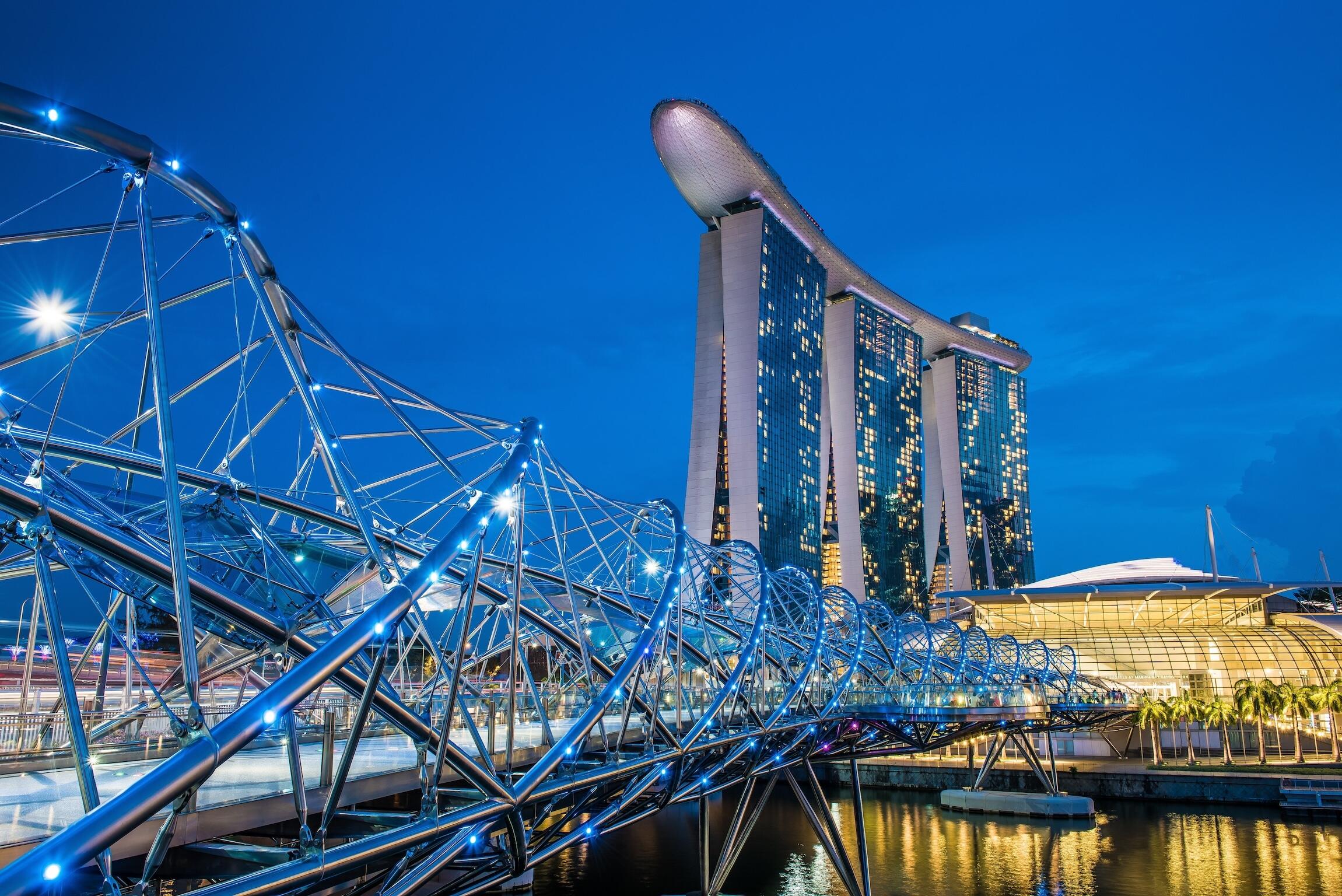
Helix Bridge: Marina Bay’s Futuristic Pedestrian Landmark
Opened in 2010, Helix is one of the most recognisable modern bridges. It is also one of the longest pedestrian bridges in the country6.
Overlooking Marina Bay, its 280-metre steel structure takes inspiration from the double-helix form of DNA, creating a striking pedestrian crossing between Bayfront and Marina Centre. Four viewing pods extend over the water, offering wide views across the Marina Bay skyline.
At night, the bridge lights up with specialised LED lighting that traces the curved steel spirals, making it a popular spot for photography and watching the light shows.
From the bridge, you can see Marina Bay Sands, the ArtScience Museum and the waterfront promenade. Promenade MRT and Bayfront MRT are convenient starting points, depending on your route.
For a longer evening walk, continue towards Gardens by the Bay or explore the waterfront around Marina Bay. You can also check the current schedule for Spectra, the light and water show at Marina Bay Sands.
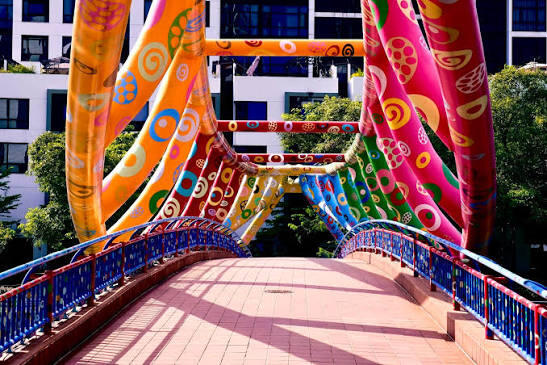
Alkaff Bridge: Singapore’s Colourful Art Bridge
Near Robertson Quay, Alkaff Bridge stands out for a completely different reason: its colourful painted surface. Famously known as the “Singapore Art Bridge,” it is a vibrant, pedestrian-only footbridge7.
The 55-metre-long steel bridge is uniquely shaped like a tongkang, a traditional lightweight wooden boat that was widely used to transport goods along the Singapore River during the country's early trading days.
The pedestrian bridge is a convenient stop while exploring the Singapore River promenade, with cafés, restaurants and waterfront spaces nearby. The bridge was named after the Alkaff family, a prominent Yemeni-Arab family that owned the former Alkaff Quay nearby. In 2003–04, Filipino artist Pacita Abad painted it with colourful patterns using 52 different colours.
🚶🏽♀️➡️Self-Guided Singapore River Bridges Walking Route
If you want to see several bridges without spending a whole day getting between different parts of the island, a riverside walk is one of the easiest options. Start at Read near Clarke Quay MRT and follow the river east towards Elgin. Continue past Boat Quay and the Civic District towards Coleman, then head towards Cavenagh and nearby Anderson. From there, extend the walk towards Marina Bay and finish at Helix.
The full route is around 3km, depending on your exact route and detours, and can take around 1.5 to 2.5 hours without lengthy meals, museum or photography stops. Allow extra time to explore nearby attractions, including religious sites in Singapore if you want to extend your sightseeing beyond the waterfront.
| Route stop | Nearby MRT | Nearby attraction |
|---|---|---|
| Read Bridge | Clarke Quay | Clarke Quay |
| Elgin Bridge | Clarke Quay | Boat Quay |
| Coleman Bridge | Clarke Quay | Old Hill Street Police Station / Civic District |
| Cavenagh Bridge | Raffles Place | Fullerton precinct |
| Anderson Bridge | Raffles Place / City Hall | National Gallery |
| Helix Bridge | Promenade / Bayfront | Marina Bay Sands |
Start early if you want cooler conditions and fewer crowds, or walk after 6.30 pm for the evening atmosphere and illuminated skyline. Bring water, sunscreen and an umbrella, and wear comfortable shoes. It is also worth checking MRT service information and road closures before major events such as the National Day Parade or the Formula 1 Singapore Grand Prix.
💡Tips for Photographing and Visiting Famous Bridges in Singapore
The best time to photograph depends on the bridge and the atmosphere you want. Morning works well for Cavenagh and Boat Quay, when the riverfront is generally quieter and strong midday light is less of a problem. For Anderson and Elgin, try sunset or blue hour, when the changing light can bring out their arches, lamps and reflections. Helix is especially striking after dark, when its illuminated structure contrasts with the Marina Bay skyline.
Try different compositions rather than photographing only the bridge itself. A wider shot can work well at Helix, while Anderson suits symmetrical architectural shots. At Cavenagh, look for details in the suspension cables and historic signs; along Elgin, include the river and colourful shophouses for added context.
Keep pedestrian paths clear, stay behind safety barriers and avoid climbing railings. Look around you, too: bumboats, shophouses, civic buildings and the skyline can turn a simple bridge photograph into a snapshot of the surrounding area.
Best times to visit
- Morning: Cavenagh Bridge and Boat Quay
- Sunset: Anderson and Elgin bridges
- Night: Helix Bridge
✈️Explore Singapore Through its Historic Bridges
The lion city is not only a place for good food, skyscrapers and shopping. Besides visiting better-known sights, you can also include these bridges in your itinerary to discover another side of the country. These crossings carry stories from different generations and show how much the nation has evolved since the colonial era.
From historic river crossings and colourful shophouses to modern structures overlooking Marina Bay, a walk across these bridges offers a different way to explore the country’s past, from colonial-era trade to the events remembered at historical war sites.
References
- NLB. (n.d.). https://www.nlb.gov.sg/main/article-detail?cmsuuid=563a3d5a-6323-49a4-8f38-fccfd2855c6c
- NLB. (n.d.). https://www.nlb.gov.sg/main/article-detail?cmsuuid=13e377d8-020f-4eb6-935b-e9ee85ccdfc4
- NLB. (n.d.). https://www.nlb.gov.sg/main/article-detail?cmsuuid=361eaff3-9999-437e-b57f-375313b46ffd
- NLB. (n.d.). https://www.nlb.gov.sg/main/article-detail?cmsuuid=df446a5b-96e8-4da1-ae2d-f4906b3636aa
- NLB. (n.d.). https://www.nlb.gov.sg/main/article-detail?cmsuuid=20e7b062-2af1-4ec6-a509-848bf670ccf0
- NLB. (n.d.). https://www.nlb.gov.sg/main/article-detail?cmsuuid=40fb2a37-ebfd-4d9b-8a6c-2a0759bc9b59
- Singapore, H. (2020, May 17). Alkaff Bridge — Hello! Singapore Tours. Hello! Singapore Tours. https://www.hellosingaporetours.com/blog/alkaff-bridge
Summarise with AI:
Did you like this article? Leave a rating!

 Loading...