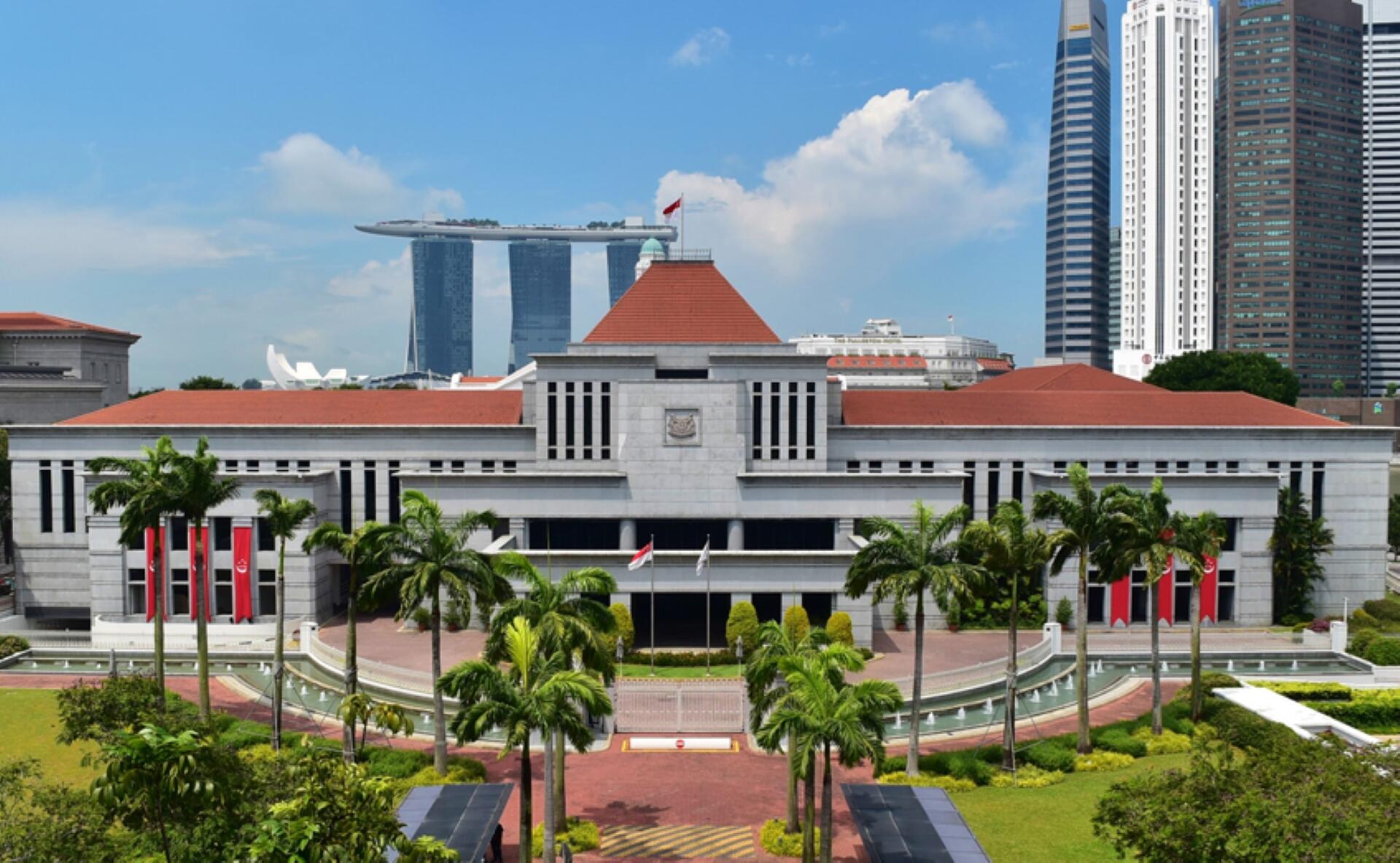

Singapore's Parliament is a fundamental component of the nation’s democratic process and operates as a unicameral legislature within a Westminster-style system. It plays a vital role in enacting laws, scrutinising government policies, and representing the interests of the populace through elected Members of Parliament (MPs), Non-Constituency MPs (NCMPs), and Nominated MPs (NMPs).1
Alongside the President, Parliament governs the country and serves as a forum where policies are debated and scrutinised, which ultimately shapes the country’s public policy.
| Category of Member | Description | How Selected | Typical Number | Key Role |
|---|---|---|---|---|
| Elected Members of Parliament (MPs) | Main representatives of the people | Elected through general elections from Single Member Constituencies (SMCs) and Group Representation Constituencies (GRCs) | ~90+ | Form the core legislature; debate and pass laws |
| Non-Constituency Members of Parliament (NCMPs) | Opposition members who were not elected but performed best among losing candidates | Appointed from opposition parties after elections | Up to 12 (including elected opposition MPs to ensure minimum opposition presence) | Provide opposition voice and scrutiny |
| Nominated Members of Parliament (NMPs) | Non-partisan members representing various sectors (arts academia business etc.) | Appointed by the President on recommendation of a special committee | Up to 9 | Offer independent non-political perspectives |
| Speaker of Parliament | Presiding officer of Parliament | Elected by MPs | 1 | Maintains order and oversees parliamentary proceedings |
| Deputy Speakers | Assist the Speaker | Elected by MPs | Usually 1–2 | Support in managing sessions |


🇸🇬 Overview of Singapore's Parliamentary System
The Three Branches of Government
The Singapore government operates through three branches: the Legislature, the Executive and the Judiciary, which govern the country together. However, while these three branches are separate, they are closely interlinked. Here is how they work together.
- The Legislature consists of the President and Parliament and makes laws
- The Executive comprises Cabinet Ministers and office-holders, and is led by the Prime Minister and executes those laws
- The Judiciary interprets the law through the Courts
📜Legislature (Parliament)
The Singapore Legislature is the Parliament, and it consists of the President and Members of Parliament (MPs), including elected, non-constituency MPs (NCMPs), and Nominated MPs (NMPs). It is responsible for:
✅Making laws, debating issues of national importance and amending and passing Bills.
✅Approving the national budget and keeping tabs on government spending.
✅Questioning the government on its actions and policies.
Parliament sits at the apex of our system of democracy. It is where the most important matters of state are discussed; laws are enacted; supplies of money are voted, with the Government setting the direction and proposing policies, while answering to the public through Parliament, and the Opposition holding the Government to account, while also being a government-in-waiting should the ruling party lose the support of the people.
Speech by PM Lee Hsien Loong on the Report of the Committee of Privileges
🏛️ 2. Executive (Government)
The Executive is led by the Prime Minister and includes the Cabinet (Ministers) and other office holders. The Executive is led by the Prime Minister and includes the Cabinet (Ministers) and other office holders.
✅Together, they are responsible for implementing laws and managing the day-to-day running of government ministries
✅They prepare and enact most legislation, including the budget
✅The Executive also manages foreign affairs and national security
⚖️ 3. Judiciary (Courts)
The Judiciary of Singapore is independent and is responsible for interpreting and applying laws. Led by the Chief Justice, the Judiciary ensures everyone is treated equally before the law and has recourse to justice.
The Judiciary comprises of the
✅Supreme Court, which includes the
- Court of Appeal (highest court)
- High Court
✅State Courts (lower courts) comprise District and Magistrate Courts
✅Family Justice Courts
Unicameral Nature of Parliament
The Singapore parliament is unicameral (single-house) in nature, meaning all functions are carried out in one chamber. This means all power is concentrated with Parliament, allowing for better and more streamlined working.
In contrast, bicameral systems consist of two separate legislative houses, an upper legislative chamber and a lower legislative chamber. This arrangement provides for checks and balances and reduces the risk of ill-thought-out, hasty decisions. However, this can result in slower decision-making and delays in the execution of policies.
This is the reason why Singapore has adopted a unicameral parliament, with this principle being clearly enshrined in the Constitution.
We think the continued practice of a sound democratic system of government in Singapore will best be achieved if our recommendations leave untouched a unicameral legislature which we have at present, where all Members of Parliament are elected by the people by secret vote at elections held at regular intervals of years. In this way the many and grave responsibilities which Members of Parliament take upon as the elected representatives of the people will rest solely on them.
Paragraph 54, Page 15 of the Report of the 1966 Constitutional Commission
📜Composition of Parliament
The Singapore Parliament is a single house and comprises three types of Members of Parliament2:
- Fully elected Members of Parliament
- Non–Constituency Members of Parliament (NCMP)
- Nominated Members of Parliament (NMP)
1️⃣Elected Members of Parliament (MPs)
The elected MPs are the candidates who win the maximum number of votes in general elections held through a one-man-one-vote system based on a simple majority count. The MPs could either be returned from Single Member Constituencies or Group Representation Constituencies.
After the elections, the leader of the political party that secures the majority of seats in parliament is invited by the President to become the Prime Minister and lead the government.
2️⃣Non-Constituency Members of Parliament (NCMPs)
Non-Constituency Members of Parliament NCMPs were introduced by Mr Lee Kuan Yew in 1984 as a way “to educate a younger generation of voters who miss the political conflict of the 50s and 60s” and “dispel suspicions of alleged cover-ups of wrongdoings.”
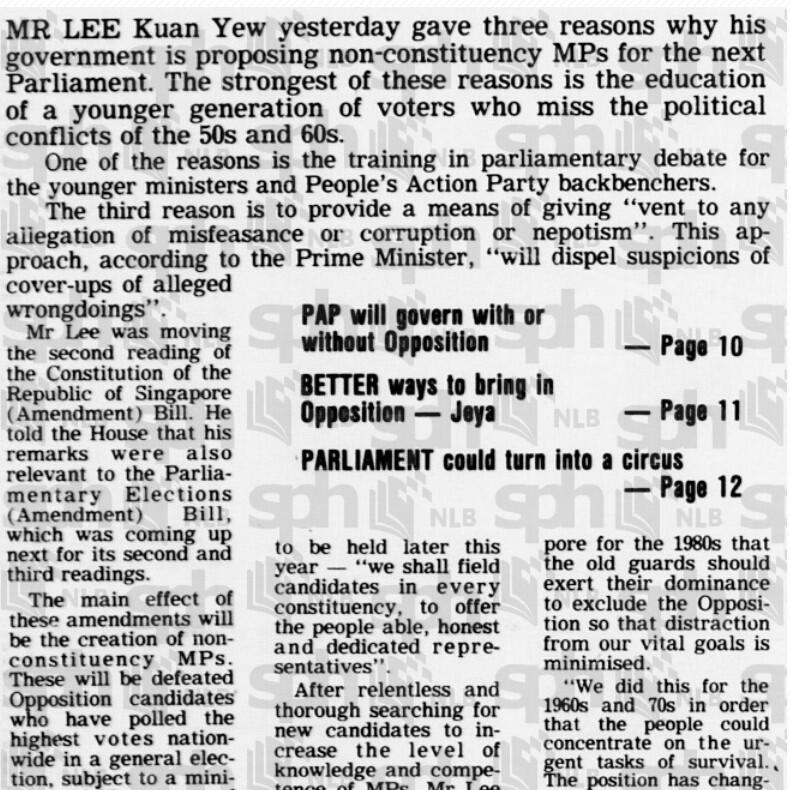
✅Under this scheme, an opposition candidate who loses but secures at least 15% of the vote is appointed as an NCMP.
✅If fewer than twelve opposition members are elected in the general election, then the ‘best losers’ are selected to bring the total number to 12.
✅They can debate in Parliament but cannot vote on constitutional or financial matters.
Thanks to the NCMP, there is always an opposition presence in Parliament even if the ruling party wins all the seats.
3️⃣Nominated Members of Parliament (NMPs)
The nominated Members of Parliament (NMPs) are individuals who are not elected by the people but nominated by a Special Select Committee of Parliament and appointed by the President. Their role in the parliament of Singapore is to provide a non-partisan and independent perspective on issues.
Up to a maximum of 9 members can be elected as NMPs.
Similar to NCMPs, NMPs also cannot vote on monetary or constitutional matters.
If you are wondering how many members of parliament there are in Singapore and whether NMPs are indeed included in the total count, yes, they are considered very much a part of Parliament.
👩⚖️The Legislative Process in Detail
1️⃣ Introduction of Bills
One of the important functions of the Legislature is lawmaking. Laws are made by the introduction of Bills. In Singapore’s Parliament, members can introduce two types of Bills: Government and Private Members' Bills.
Government Bills are introduced by Ministers on behalf of the government when they want to amend laws or create new ones. On the other hand, Private Bills are introduced by Members of Parliament who are not Ministers. These Bills typically promote the interests of a particular person, group or association.
The Legislative process that developed during British colonial rule begins with the First Reading, where a Bill is introduced in Parliament.
During this process, the Minister reads out the long title of the Bill, after which the Clerk of Parliament reads out the Bill’s short title.
The Bill is then gazetted and distributed by the Clerk of Parliament to the Members of Parliament.
Remember: After gazetting, seven days must lapse before the Second Reading of the Bill can take place.
In the Second Reading, the merits and principles of the Bill are discussed in Parliament. A vote is held to decide if it should be read for a second time or not. If the Second Reading is rejected, then the Bill is deemed to have been defeated.
In the Committee stage, the Bill is scrutinised by a Select Committee and analysed clause by clause.
In the Third Reading, amendments for the correction of errors or oversights may be proposed. Afterwards, the Bill is put to a vote. If it is approved, it means the House has officially passed the Bill.
The Bill is sent to the President for assent, and after their formal approval, it becomes an Act of Parliament.
2️⃣ Oversight and Accountability
Under the Westminster structure of governance, the executive branch is answerable to the legislature. To check if the government is performing properly, there is the provision of parliamentary questioning and committee investigations.
The Question Time is a key mechanism where Members of Parliament ask Ministers about matters within their respective ministries. This process keeps the government on its toes and also allows the public to understand how decisions are made and how it will impact their lives.
3️⃣Financial Scrutiny
Parliament plays a crucial role in keeping track of the expenses made by the government. To run the country, the government needs funds, and for that, it prepares an annual Budget.
The annual Budget is thoroughly scrutinised and debated before being approved. The process typically lasts for 7 to 10 days. For greater transparency, the Budget Book also contains Estimates of Expenditure showing how each Ministry is going to use the allocated funds.
Once the Budget is passed, the government is allowed to withdraw funds from the Consolidated and Development Funds to finance public services.
🧑💼Key Figures in Parliament
Speaker of Parliament
The Speaker is the main presiding officer of Parliament and holds the most important post in Parliament. Since the Speaker chairs the meetings of the House, they are also referred to as the “House’s presiding officer.”
The speaker is elected by the House at the beginning of each new Parliament from among persons who may or may not be Members of Parliament. However, the speaker should be eligible to stand for election as an MP.
✅The Speaker presides over the House and enforces the rules governing it.
✅He proposes and puts the question for the House to debate and vote upon.
✅The Speaker decides who can speak in Parliament.
✅Guides Members on matters of practice and procedure, and he decides on points of order when required.
👔 Prime Minister and Cabinet
The member of Parliament who commands the confidence of the majority of the MPs is appointed as the Prime Minister by the President. Based on the Prime Minister’s recommendations, the President appoints other ministers from among the Members of Parliament to form the Cabinet.
The Cabinet, led by the Prime Minister, comprises of the elected Members of Parliament who are “responsible for all government policies and the day-to-day administration of the affairs of state.”
The Cabinet is collectively responsible to Parliament, and comprises of:
🔥Prime Minister
🔥Deputy Prime Ministers and
🔥Ministers in charge of the ministries of Digital Development and Information, Finance, Foreign Affairs, Community and Youth, Manpower, Law, Defence, Culture, Education, Health, Home Affairs, National Development, Social and Family Development, Sustainability and the Environment, Trade and Industry, and Transport.
🧑💼Leader of the Opposition
The Leader of Opposition (LO) is a Member of Parliament who represents the opposition leaders as their spokesperson. Unlike other Westminster parliamentary systems, where the position is formally established, in Singapore, the LO was an unofficial position in Singapore’s legislature till 2020.
During the 2020 General Elections (GC), the Workers’ Party won a second Group Representation Constituency (GRC). Noting these results, Prime Minister Lee Hsien Loong said that this reflected Singaporeans’ desire for greater diversity in politics.
Know how GRC's ensure opposition voices in Parliament.
Subsequently, in a joint press statement issued by the Office of the Speaker of Parliament and the Office of the Leader of the House, the government announced the formal designation and appointment of the LO. This move enabled Singapore’s political system to “evolve in a way that maintains our sense of national purpose.”
I believe there is a role for the opposition to play in our politics, in our democracy, and a very important role to campaign for your ideas and your proposals to hold the elected government to account and to offer serious alternatives to the government.
Lawrence Wong
Functions of the Leader of the Opposition
- Lead the opposition and present alternative views on various Bills and policies
- Scrutinise the government’s action and position in parliament
- Being consulted on the appointment of opposition Members to Select Committees, including Standing Select Committees such as the Public Accounts Committee
- Maintain parliamentary decorum
You can watch Singapore’s parliamentary debates live on the Ministry of Digital Development and Information (MDDI) YouTube channel during sitting days. Recorded sessions of parliamentary debates are also uploaded on YouTube. Written transcripts (Hansard) are published online a few days after each sitting.
🗣️Becoming a Member of Parliament
Eligibility Criteria
Elections in Singapore are administered through the Elections Department. To be a Member of Parliament (MP) and work in the Singapore government structure, one has to meet the following criteria:
✨Must be a Singapore citizen
✨Must be aged 21 or above
✨Must be on the register of electors
✨Must have resided in Singapore for at least ten years
✨Must never have been convicted by a court of law and sentenced to imprisonment for a term of not less than one year or a fine of not less than S$2,000
Following the 2025 General Election(GE), there are:
Total Elected MPs: 97
Non-constituency MPs (NCMPs): 2
Nominated MPs (NMPs): 9
Total Members: 108
Election Process
Nominations
The Nomination Day is specified in the Writ of Election, and the Returning Officer notifies the public of the date.
As per law, Nomination Day has to be at least 5 days (not including Sundays or public holidays) and not more than one month after the date of the Writ of Election.
On Nomination Day, nominations open at 11 am and close at 12 noon, during which candidates have to deliver the nomination papers in duplicate to the Returning Officer at the Nomination Place.
For SMCs, candidates have to submit:
- Nomination paper and
- Political Donation Certificate issued to the candidate
For GRCs, candidates need to submit:
✨the nomination paper
✨Political Donation Certificate issued to each candidate in the group
✨Relevant Minority Community Certificate for the community designated for the GRC
Campaigning
Campaigning begins after nomination proceedings on Nomination Day and ends with the start of the eve of Polling Day (i.e. Cooling-off Day).
When campaigning:
✅Candidates must maintain proper decorum when campaigning
✅Candidates should steer away from negative campaigning practices
✅Candidates should also avoid making false statements that can cause racial or religious tensions
✅Candidates must also ensure that their campaign is free from foreign influence
Remuneration and Responsibilities
Under Singapore’s system, the salary structure of Members of Parliament is as follows:
📍a fixed pay for 13 months
📍+ 1 month of annual variable component
📍+ 3 months of individual performance bonus
📍+ 3 months of the national bonus
= 20 months in total.
Recent Developments in the 15th Parliament
| Legislation / Bill | Year | Key Provisions | Sector | Impact |
|---|---|---|---|---|
| Cybersecurity (Amendment) Act | 2024 (carried into current parliamentary cycle) | Expands scope to more entities, strengthens incident reporting, increases penalties | Digital security / Critical infrastructure | Improves national cyber resilience; increases compliance burden on firms; strengthens protection against rising cyber threats |
| AI Governance & Digital Inclusion Policies (emerging framework) | 2025–ongoing | Focus on inclusive AI, accessibility standards, and regulation of bias in AI systems | Technology / Social policy | Aims to reduce digital divide; ensures equitable AI adoption; may lead to future binding regulation |
| Smart Nation 2.0-related legislative updates | 2024–2026 | Enhances digital services standards, accessibility, and integration of public tech systems | Digital governance | Improves public service delivery; pushes digitalisation across sectors; raises standards for gov-tech accessibility |
| Manpower & Employment Regulation Updates | 2024–2025 | Raises salary criteria for foreign workers; prioritises high-skilled labour | Labour / Economy | Protects local workforce; increases costs for firms hiring foreign talent; shifts labour market toward high skills |
| Economic & Trade Resilience Measures | 2025–ongoing | Strengthens trade agreements, supply chain resilience, and international partnerships | Economy / Trade | Enhances Singapore’s global competitiveness; diversifies economic dependencies; supports long-term growth |
| National Security & Defence-related legislative updates | 2025–ongoing | Updates national service roles, expands participation, integrates technology | Defence / Security | Strengthens defence readiness; modernises military roles; increases societal participation in security |
Key Legislation Passed
📌Cybersecurity (Amendment) Act
The 2024 amendments to Singapore’s Cybersecurity Act, effective 31 October 2025, have added certain new amendments. The Commissioner of Cybersecurity may now designate third-party or virtual systems, including those located overseas, as Critical Information Infrastructure (CII) if they are essential to services in Singapore. Organisations must provide system information upon request, with non-compliance attracting strict penalties.
The Act will now allow CSA to designate computer systems located wholly or partly in Singapore as Systems of Temporary Cybersecurity Concern (STCCs) for a limited period if they pose any threat to Singapore’s national interests.
📌Online Safety Relief and Accountability Bill (Passed November 2025)
On 5th November 2025, the Online Safety Relief and Accountability Bill (OSRA Bill) was passed after a prolonged 8 hours of debate. The Bill aims to:
👉 Protect victims of online harms (such as bullying, stalking, doxxing, and intimate image abuse) by establishing the Office of the Commissioner of Online Safety (OSC).
The OSC is intended to be a “one-stop shop” for victims to seek assistance. Those victims of severe harm will receive help immediately, while others must first report to the relevant platform and wait 24 hours before escalating to the OSC.
📌Workplace Fairness Act (Passed January 2025)
On 8 January 2025, the Singapore Parliament passed the Workplace Fairness Bill (WFA), a significant step towards enhancing protections against workplace discrimination. The WFA formalises workplace discrimination governance by statute for the first time, enabling employees to seek remedial measures from their employers.
The role of the Parliament of Singapore is to shape the nation’s policy through law-making and holding the government accountable for its actions. Through Singapore parliamentary debates, members of parliament of Singapore ensure policies are carefully debated, and public funds are properly utilised. In essence, singapore parliament structure works to strengthen democracy and promote effective governance.
References
- Parliament of Singapore. (n.d.). A GUIDE TO THE PARLIAMENT OF SINGAPORE. https://www.parliament.gov.sg/docs/default-source/default-document-library/fa_parliament-e-brochure.pdf
- Tan, K. P. (2013). The Singapore Parliament: Representation, effectiveness, and control. In Y. N. Zheng, L. F. Lye, & W. Hofmeister (Ed.), Parliaments in Asia: Institutional Building and Political Development (pp. 28–29). Routledge. https://www.academia.sg/wp-content/uploads/2020/06/Tan-2013-Parliament.pdf
Summarise with AI:
Did you like this article? Leave a rating!

 Loading...