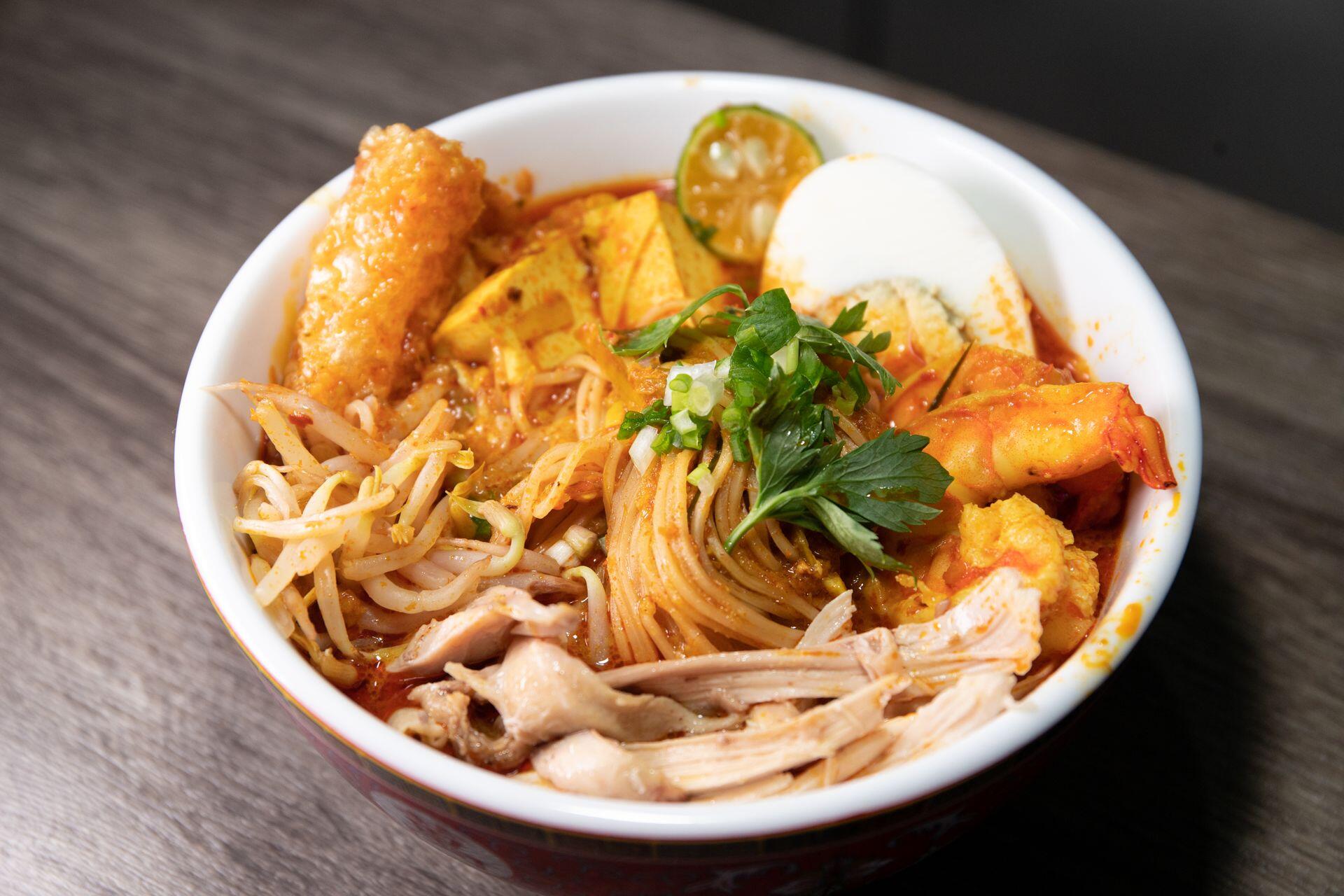

Laksa Singapore is a rich, fragrant and deeply comforting spicy noodle dish that reflects the city’s Peranakan and hawker-food traditions. While laksa takes many forms across Southeast Asia, Singapore laksa is best known for its creamy, orange coconut-milk-based curry broth, seafood, sambal and aromatic spices.
This guide covers the best laksa in Singapore, what makes Katong laksa special, the origin of laksa and its regional varieties, and how to make laksa at home using a simpler approach.
| Question | Quick Answer |
|---|---|
| Where can I find the best laksa in Singapore? | This guide covers notable laksa stalls and restaurants across Singapore, including famous names such as Janggut Laksa, 328 Katong Laksa, Roxy Laksa, Sungei Road Laksa and other long-running hawker stalls. |
| What is Singapore laksa? | Singapore laksa is a rich, spicy noodle dish made with thick rice vermicelli, a coconut milk-based curry broth, seafood, spice paste and toppings such as prawns, fish cake, cockles and fried tofu puffs. |
| Where is laksa from? | The exact laksa origin is uncertain. The dish is closely associated with Peranakan food traditions and has developed into wide regional varieties across Southeast Asia, including Singapore, Malaysia and Indonesia. |
| What is Katong laksa? | Katong laksa is a distinctive Singapore style known for its rich coconut-based gravy, short-cut rice vermicelli, seafood toppings and traditional spoon-only eating style. |
| What is the difference between Katong laksa and Singapore laksa? | Katong laksa is one style of Singapore laksa. While both typically use a rich coconut milk-based gravy, Katong laksa is particularly known for its short noodles, seafood toppings and spoon-friendly serving style. |
| What does Singapore laksa taste like? | Singapore laksa is typically creamy, savoury, aromatic and spicy, with coconut milk providing richness and dried shrimp, shrimp paste, seafood and sambal adding umami depth. |
| What are the main ingredients in Singapore laksa? | Common ingredients include rice noodles, coconut milk, laksa paste, chillies, shallots, garlic, galangal, lemongrass, turmeric, belacan, prawns, fish cake, cockles, fried tofu puffs, laksa leaves and sambal. |
| How much does laksa cost in Singapore? | Prices vary by stall and location, but hawker-centre laksa is generally affordable, while restaurant versions and premium bowls can cost more. Check the comparison table for the typical price at each recommended stall. |
| Which laksa should I try first? | If you're new to Singapore laksa, start with a classic coconut-rich curry laksa or Katong laksa with prawns, fish cake and cockles to experience the flavours most commonly associated with the dish. |
| What are the different types of laksa? | Popular regional varieties include curry laksa, Nyonya laksa, Katong laksa, Assam laksa and Penang laksa. They can differ significantly in their broths, noodles, seafood and spice profiles. |




📜Laksa Origin: Where Is Laksa From?
The exact origin is difficult to trace to a single place, and there are different theories about where the dish and its name came from. Laksa is closely linked to the Peranakan or Straits Chinese community, whose food combines Chinese, Malay and Indonesian influences1.
The origin of the word “laksa” is also debated. One theory links it to the Hindi word lakshah, meaning “hundred thousand”, possibly referring to the many ingredients used in the dish.
Another theory suggests that it comes from the Persian word lᾱkcha, which refers to vermicelli, macaroni, or long slices of paste put into broth.
The origins of the noodle dish as it developed in Singapore are also unclear. One possibility is that it was created by the Peranakans, or Straits Chinese. The use of rice noodles reflects Chinese culinary traditions, while the aromatic spice paste has strong Malay and Southeast Asian influences.
The dish is widely found across Southeast Asia, including Malaysia, Indonesia, and Thailand.
Different regions created their own interpretations using ingredients available locally, resulting in broths that can be creamy and coconut-rich, sour and tamarind-based, or intensely spiced.
These differences are part of what makes laksa so interesting. There is no single recipe that defines the dish across Southeast Asia. Its many regional forms also reflect the wider traditions found across the city’s hawker centres.
The Key Ingredients in Singapore Laksa
A typical bowl starts with thick rice vermicelli or rice noodles served in a creamy laksa broth made from coconut milk and a fragrant laksa paste.
Here’s a closer look at the ingredients that give the dish its distinctive flavour, aroma and texture.
The spice paste
The spice paste forms the flavourful, complex base of the broth. It typically contains dried or fresh chillies, shallots, garlic, ginger, galangal (blue ginger), lemongrass, fresh turmeric, candlenuts (buah keras), belacan (fermented shrimp paste) and dried shrimp.
The broth base
The broth is typically made with prawn stock and coconut milk (santan), giving it a rich, creamy texture and deep seafood flavour.
Noodles and main toppings
Thick rice vermicelli, also known as laksa bee hoon, forms the base of the dish. Common toppings include fresh blood cockles (hum), prawns, bean sprouts, fish cake and fried tofu puffs, which soak up the rich broth. Some hawker stalls serve yellow egg noodles (mee).
Beyond the traditional toppings, some stalls also offer additional or premium options such as lobster, tiger prawns, scallops, clams, fried beancurd rolls, long beans, quail eggs, crispy roast pork (sio bak) and more.
Garnish and accents
Laksa leaves (daun kesum) add a fresh, aromatic note, while sambal chilli provides an extra layer of heat and spice. A spoonful of sambal chilli is often served alongside or added to the bowl for extra heat.
The exact ingredients can vary by hawker stall and family recipe. Some versions are heavier on seafood, while others have a richer coconut milk base, more chilli or different kinds of toppings.
The combination of creamy coconut milk, dried seafood, aromatic spices and fresh herbs gives the dish its signature flavour. Chilli adds heat, while shrimp paste and seafood provide a deep, savoury umami note. Together, these elements create a rich and balanced broth.
🤩Best Laksa in Singapore: Recommended Stalls and Restaurants
| Stall / Restaurant | Nearest MRT | Style | Typical Price Range |
|---|---|---|---|
| Janggut Laksa, The Original Katong Laksa | Marine Parade | Heritage Katong-style | ~S$6–8 |
| 328 Katong Laksa 🏆 Bib Gourmand | Marine Parade | Classic Katong-style, coconut-rich | ~S$6–8 |
| Katong Laksa (George’s) | Eunos | Katong-style | ~S$5-6.50 |
| Terry Katong Laksa | Telok Ayer/Tanjong Pagar | Katong-style, MSG-free | ~S$10.50 |
| Khoon’s Katong Laksa & Seafood Soup | Upper Thomson | Katong-style laksa & seafood soup | ~S$6–10 |
| Sungei Road Laksa | Jalan Berseh / Jalan Besar | Old-school charcoal-cooked laksa | ~S$4–6 |
| Sungei Road Trishaw Laksa 🏆 Bib Gourmand | Chinatown | Traditional-style hawker laksa | ~S$4–6 |
| Alexandra Village Depot Road Zhen Shan Mei Claypot Laksa 🏆 Bib Gourmand | Queenstown/Redhill | Rich, creamy laksa | ~S$5–9 |
| 928 Yishun Laksa | Yishun | Rich heartland curry laksa | ~S$4–6 |
| Heng Heng Cooked Food | Chinese Garden | Rich, aromatic hawker laksa | ~S$4–7 |
| Wei Yi Laksa & Prawn Noodle | Commonwealth | Customisable, seafood-heavy laksa | ~S$3–6 |
| 63 Laksa | Buona Vista | Sungei Road-style laksa | ~S$3–5 |
| Guang Fa Laksa | Havelock / Tiong Bahru | Spicy, cockle-heavy laksa | ~S$4–7 |
| Min Ji Laksa | Boon Keng | Traditional curry laksa | ~S$3.50–6 |
| My Cosy Corner | Tan Kah Kee | Peranakan-style local laksa | ~S$10–15 |
| King of Laksa (Kotthika’s Fusion Laksa) 🏆 Bib Gourmand 2026 | Aljunied | Lighter, health-conscious fusion laksa | ~S$8–10 |
Here are some notable laksa stalls and restaurants around Singapore, with hawker centres offering affordable local meals alongside more established eateries. Prices shown are approximate and may differ from the actual prices at the stalls or restaurants. Check individual listings online for full addresses, opening hours and other details.
🍜Best Katong Laksa in Singapore
Folks looking for Katong laksa can try one of these famous spots for an authentic taste:
- Janggut Laksa
- 328 Katong Laksa
- Katong Laksa (George's)
🍲Best Traditional and Old-School Laksa
Perhaps you're looking for a traditional and old-school experience?
Possible choices:
- Sungei Road Laksa
- Sungei Road Trishaw Laksa
- 928 Yishun Laksa
🦐Best Laksa for Seafood Lovers
If you judge a bowl by its toppings, look for stalls that make the seafood a noticeable part of the experience.
- Guang Fa Laksa
- Wei Yi Laksa & Prawn Noodle
- Khoon's Katong Laksa & Seafood Soup
🏆Michelin-Recognised Laksa Stalls
If you want to try a stall with Michelin recognition, here are some recommendations:
- King of Laksa — current 2026 Bib Gourmand
- 328 Katong Laksa — historical Michelin recognition
- Sungei Road Trishaw Laksa — Michelin Bib Gourmand recognition
- Depot Road Zhen Shan Mei — Michelin Bib Gourmand recognition
These recognitions should be viewed as an additional reference rather than proof that these stalls are better than the others. Michelin’s recognition is indeed a big deal, but laksa is ultimately a dish where personal taste plays a major role.
There is no single “best” laksa for everyone. Some people prefer a rich, coconut-based laksa broth, while others like stronger dried shrimp flavours, more sambal or a lighter seafood-based bowl. Use the categories above to find the style that suits you best.
🤔What Makes Katong Laksa Different?
History of Katong Laksa
Katong laksa is one of the best-known styles of Singapore laksa. It is closely connected to East Coast Road and the area’s Peranakan community. According to Singapore heritage sources, brothers Ng Juat Swee and Ng Chwee Seng helped popularise the dish along East Coast Road in the mid-20th century2.
Ng Juat Swee was better known as “Janggut,” a Malay nickname meaning “bearded,” reportedly referring to the hair growing from a mole on his chin.
Janggut learned to cook Katong laksa from his Peranakan neighbours, and later developed his own version of the dish. One story says that he cut the noodles into short pieces so customers could eat them quickly, especially when street hawkers had to deal with authorities.
However, this practical adjustment that he made then eventually became one of the defining features of Katong laksa today.
When street hawking became more regulated, Janggut moved into a stall at East Coast Road. As the stall became closely associated with the Katong area, customers gradually began using the name “Katong laksa” for this style of noodle soup.
The Katong Laksa Style
There is no single universally accepted answer to which stall serves the “original” Katong laksa. Several businesses have links to the early East Coast Road stalls, while others developed their own interpretations as the dish became popular. Janggut Laksa’s family says that its distinctive rempah, or spice paste, remains a secret and has been preserved within the family.
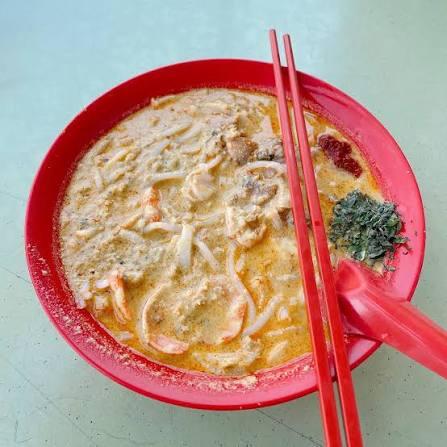
The recipe has also changed slightly over the decades. According to the Janggut family account reported by CNA, their earlier version was cooked over charcoal before the business switched to gas for practical reasons3.
Cockles were added later because customers requested them, although they are now commonly associated with the wider Katong laksa style.
What remains consistent is the combination of a fragrant curry broth, coconut milk, seafood, and short-cut rice noodles, traditionally eaten with a spoon. The noodles are cut into small pieces so the entire dish can be eaten without chopsticks or a fork.
Is Katong Laksa the Same as Singapore Laksa?
Not exactly. It is one popular style of laksa, but not every bowl of laksa in Singapore is Katong laksa.
Different stalls may use different spices, coconut milk ratios, seafood stocks and noodle styles. This means Katong laksa is best understood as one distinct style within the wider range of Singapore laksa.
| Feature | Katong Laksa | General Singapore Curry Laksa |
|---|---|---|
| Noodles | Short, thick rice vermicelli noodles, snipped into short pieces | Full-length thick rice vermicelli, yellow egg noodles, or a mix |
| Broth | Thick, creamy and rich in coconut, with a strong spice paste and seafood flavour | Rich, creamy and coconut-based, with the exact balance of spices, seafood and coconut milk varying by stall |
| Toppings | Prawns, cockles and fish cake are common | Toppings vary by stall and may include prawns, cockles, fish cake, tofu puffs and eggs |
| Sambal | Often added for extra heat and flavour | May be included or served separately |
| Eating style | Traditionally eaten with a spoon because the noodles are cut into short pieces | Usually eaten with chopsticks and a spoon |
🌏Singapore Laksa vs Other Types of Laksa
| Country | Common Laksa Styles | What Makes It Different |
|---|---|---|
| Singapore | Singapore laksa / Katong laksa | Rich, creamy coconut milk-based broth made with a fragrant spice paste. Common toppings include prawns, fish cake, cockles and bean sprouts. Katong laksa is known for its short-cut rice noodles, which are often eaten with a spoon |
| Malaysia | Asam laksa, curry laksa, Laksa Johor, Laksa Sarawak | Malaysia has several distinct laksa styles. Asam laksa has a sour, tamarind-based fish broth, while curry laksa is creamy and spicy, often with tofu puffs and other toppings. Laksa Johor uses spaghetti instead of rice noodles and has a rich fish and coconut-based sauce (kuah). Sarawak laksa has a rich, spicy and slightly creamy broth made from a complex spice paste, usually served with rice vermicelli, prawns, chicken and egg |
| Indonesia | Laksa Betawi, Laksa Bogor and other regional styles | Indonesian laksa varies by region but often uses turmeric, daun kemangi (lemon basil), and aromatic herbs, giving the broth a yellow colour and a more herbal flavour. Some versions are served with shredded chicken, boiled egg, fried shallots or ketupat (compressed rice cakes) |
Other variations: Laksa can also be found in places such as Thailand, Myanmar and Australia, where local cooks have created their own versions of the dish. Similar regional variations can also be seen with Hainanese chicken rice, which has developed into different preparations across Southeast Asia.
🍽️How to Make Singapore Laksa at Home
You can make it at home with a good laksa paste. It may not be the same as the bowl from a hawker stall, but it can still give you the rich, spicy and creamy flavours of the dish.
- Laksa paste, homemade or store-bought
- Dried shrimp or shrimp paste
- Laksa leaves
- Rice vermicelli or yellow egg noodles
- Coconut milk
- Seafood or chicken stock
- Prawn stock (Prawn shells and heads, if making your own seafood stock)
- Prawns
- Fish cake
- Fried tofu puffs
- Bean sprouts
- Daun kesum or mint
- Sambal
Cooking method:
- Cook the laksa paste in a little oil until fragrant and thickened.
- Add the stock and simmer to let the flavours develop. If using prawn shells and heads, you can use them to make a richer seafood stock.
- Add the coconut milk and simmer gently. Avoid boiling it too hard.
- Prepare the noodles separately according to the package instructions.
- Add the tofu puffs, prawns and fish cake to the broth and cook until heated through and the prawns are done.
- Place the noodles and bean sprouts in a bowl, then pour over the hot broth.
- Finish with shredded laksa leaves and sambal to taste.
Can You Make Laksa Vegetarian?
Yes. Vegetarian laksa can be made by replacing the seafood with ingredients such as tofu, mushrooms and vegetables.
Use a vegetarian laksa paste and vegetable or mushroom stock, and check the labels carefully for shrimp, dried shrimp or other animal-derived ingredients.
The same basic recipe above can be followed with vegetarian or vegan alternatives.
😃How to Order and Eat Laksa Like a Local
Ordering laksa is simple, but a few local tips can make the experience easier.
- Choose your size. Most stalls offer small, medium or large bowls.
- Add chilli (sambal) if you can handle the heat.
- Bring cash or use local digital payment methods where accepted.
- Visit popular hawker stalls outside the busiest lunch hours if you want to avoid the biggest crowds.
- Chope a seat before you queue, or ask someone in your group to save a seat while you order.
- With Katong laksa, the short noodles make it easy to eat the dish with a spoon.
- Do not assume every laksa is vegetarian or halal. Check with the stall before ordering.
- Mix the chilli into the broth and scoop from the bottom of the bowl to get a little of everything in each bite, including noodles, bean sprouts, fish cake, cockles and tofu puffs.
- If you are exploring local breakfast favourites too, traditional kaya toast sets are another classic choice commonly found at traditional coffee shops.
👍🏻Why Singapore Laksa Is Worth Trying
Singapore laksa is more than just a bowl of spicy noodles. It is a dish shaped by innovation, creativity and adaptation across generations, reflecting the different cultures that have influenced Singapore’s food traditions.
Whether you are a local or a tourist, don’t forget to try some of the laksa spots featured in this guide. If there are places you haven’t tried yet, it’s time to start your own laksa adventure!
You can also explore Singapore’s satay stalls and different varieties to experience more of the city’s diverse culinary heritage.
Food brings people together on many different levels. It’s nourishment of the soul and body; it’s truly love.
Gina de Laurentiis~ Television personality and chef Giada De Laurentiis
References
- Tan, J. (2022). Laksa. Singapore Infopedia, National Library Board Singapore. https://www.nlb.gov.sg/main/article-detail?cmsuuid=6d5b6967-a680-4449-b3cc-91d03ab44dfd
- Katong laksa. (n.d.). SG101. https://www.sg101.gov.sg/resources/archives/heritage-katong-laksa/
- Paulo, D. A. (2025, July 31). Laksa battle in Katong and beyond — but which stall still follows the original recipe? CNA. https://www.channelnewsasia.com/cna-insider/katong-laksa-war-original-recipe-328-janggut-roxy-hawkers-4244876
Summarise with AI:
Did you like this article? Leave a rating!

 Loading...